Volume 1
A dictionary of Christian antiquities : being a continuation of the 'Dictionary of the Bible' / edited by William Smith and Samuel Cheetham ; illustrated by engravings on wood.
- Date:
- [between 1890 and 1899?]
Licence: Public Domain Mark
Credit: A dictionary of Christian antiquities : being a continuation of the 'Dictionary of the Bible' / edited by William Smith and Samuel Cheetham ; illustrated by engravings on wood. Source: Wellcome Collection.
1073/1096 (page 1053)
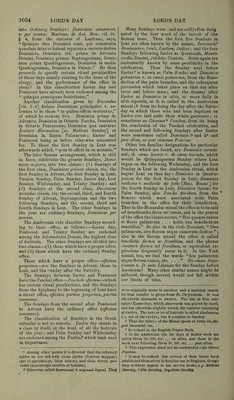
![away, to keep the sabbath in particular. The notion of connecting it with the keeping of the Lord’s day grows up in the first instance through the natural supersession of the sabbath by the Lord’s day in the Christian church, and the temptation to transfer to the Litter the positive divine sanction of the former ; and, once intro- duced, maintains itself by the very fact of pre- senting a strong and irtelligible plea against any degradati. n of the high Christian-festival. On this subject the following works may be consulted with advantage : Heylin’s History of the Sabbath, part ii., full of learning, though de- fective in arrangement and criticism ; Bingham’s Antiquities, book xx. c. ii., containing much valu- able matter, though needing some correction; Dr. Hessey’s Bampton Lectures on Sunday, pre- senting the literature of the subject accu- rately and popularly; Probst, Kirchliche I)is- ciplin der Drei ersten Jahrhuaderte (pt. iii. c. i. art. 1) discuss the principal jiassages bearing on the question found in the writers of the first three centuries; Binterim’s Denkwiirdigkeiten der Christ-Katholischen Kirche, vol. v. part i. c. 4. In all there is much common material, derived from the obvious source of informa- tion on this subject — the writings of the Fathers, the edicts of the Imperial Codes, the canons of councils, and the mediaeval laws so often based upon them. The distinction is chiefly in the inferences drawn from these historical materials. [A. B.] LORD’S DAY (Liturgical). The obser- vance of Sunday began after None on Saturday, “ ut dies Dominica a vespere usque in vesperam servetur ” {Cone. Francofurt. a.d. 794), and the reason is given by Durandus {Rat. v. 9, 2): “ Quia vespertina synaxis seu hora primum est officium diei sequentis.” The Sunday oflice Avas longer and more solemnly observed than that of other days. The number of psalms and lessons, and the number of nocturns at the night oflice was increased. The Gregorian distribution of the Psalter gives eighteen psalms and nine lessons in three nocturns, instead of twelve psalms and three lessons in one nocturn: and the Benedictine twelve psalms, and three can- ticles, with twelve lessons in three nocturns instead of twelve psalms and three lessons, in two nocturns on week days. Te Deum was said at the end of Matins, except in Advent, and from Septuagesima to Easter. The nocturnal oflice and that of Lauds were to be said (Mart, de Ant. Eccl. Bit. iv. 9) with modulation tractim, which word is explained as lenta ac morosa modulatione. Incense was offered (oblatum) at each nocturn, and the high altar censed at Benedictus at Lauds. The solemn bene- diction of the holy water “ salis et aquae,” a cus- tom which is considered to have been introduced by pope Leo IV. a.d. 847-855, took place before mass; with which ceremony a procession was in many places joined. At the mass Gloria in ex- celsis was said except dui-ing Advent, and from Septuagesima to Easter Eve: and the creed was said at the mass and at Prime in the Sunday oflice throughout the year. The reserved Eucha- rist was renewed. .Many other distinctions between the Dominical office, and that for week days, might be pointed out. Those already enumerated are among the most conspicuous. In the Ambrosian use the Dominical office differs from the Ferial in several points, of which the following are the most prominent. No psalms are said at matins, but in their place three canticles, one in each nocturn. In Nocturn 1. The Canticle of Isaiah, cap xxvi. De node vigilat. In Nocturn II. The Canticle of Hannah, 1 Reg. II. Confrmatum est. In Nocturn III. The Canticle of Jonah, cap. 1. Clamavi', or, during the winter: i.e. from the first Sunday in October till Easter, the Canticle of Habakkuk, cap. ii. Domine audivi. Each of these canticles has its proper antiphon, and is followed by the usual form. V. Benedic- tus es, Deus. R. Amen. After the third canticle three lessons are read, each with its response. These are not, as on week days, taken from scripture, but from a Homily on the Gospel of the day, and correspond therefore to the lessons in the third nocturn of the Roman BreAuary. These are folloAved, except during Adi'ent and Lent, by 7e Dcum, Avhich is not said in the ferial office, and if Lauds are said separately, the office ends with a collect, and the customary form. V. Benedicamus Domino. R. Deo Grutias. At Lauds after Benedictus, which begins the office both in the Dominical and the Ferial office,® follow, each preceded by its oratio secreta, and with its proper antiphon, the canticle cf Moses (Exod. XV.) Cantemus Domino and Benedicite. In the place of these, on Aveek days other than Saturday, Ps. 1. (li.). Miserere is said, and on Saturday, Ps. exAui. (cxviii.) Confitendni. At the other hours there are certain differ- ences in the disposition and number of the collects and antiphons, by whatever names they are called, but, as the genei-al character of the oflice is unaltered, it is not necessary to enter minutely into them. Certain greater festivals, called Solemnitates Domini, have the office nearly identical Avith that of the Sunday. In the Mozarabic rite the daily office differs throughout so much for the ordinary Western type that it is not easy to point out clearly in a few Avords the A'ariations between that of Sunday and other days. The most conspicuous A’ariation is at the beginning of matins, which on Sunday (after the opening) begin with the hymn Aeterne rerum conditor, folloAved by its oratio, and the three Psalms; iii. Domine (/uid, 1. (li.) Miserere, Ivi. (Ivii.) Miserere mei, each Avith its antiphon and oratio, Avhile on week days the correspond- ing portion of the office is an antiphon called matutinarium, and Ps. 1. (li) Miserere,^ with its antiphon and oratio. Sundays were of different degrees. The classification varied at different times, and in different churches^ but the general Western division was into Greater Sundays: Dominicae majores v. solemnes v.p'ivilegiatae : and a Except on Sundays in Advent, when the Song of Moses (Deut xxxii.), Attende Coelum, is said. On Christ- mas Day loth are said. '• This is the direction given in the Reguta printed at the head of the Breviary. In the body of the Breviary the Psalm appointed for a week-day varies among the three Sunday psalms ; and the matutinarium occurs later in the office, in the course of Lauds. The Moz- arabic ritual directions are sometimes difficult to reconcilei](https://iiif.wellcomecollection.org/image/b2901007x_0001_1073.jp2/full/800%2C/0/default.jpg)