A manual of dental mechanisms / by Oakley Coles.
- Coles, Oakley, 1845-1906
- Date:
- pref. 1876
Licence: Public Domain Mark
Credit: A manual of dental mechanisms / by Oakley Coles. Source: Wellcome Collection.
Provider: This material has been provided by the Augustus C. Long Health Sciences Library at Columbia University and Columbia University Libraries/Information Services, through the Medical Heritage Library. The original may be consulted at the the Augustus C. Long Health Sciences Library at Columbia University and Columbia University.
288/312 page 268
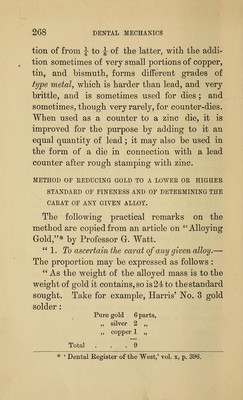
![tion of from J to -|- of tlie latter, with the addi- tion sometimes of very small portions of copper, tin, and bismuth, forms different grades of tij])e metal, which is harder than lead, and very- brittle, and is sometimes used for dies ; and sometimes, though very rarely, for counter-dies. When used as a counter to a zinc die, it is improved for the purpose by adding to it an equal quantity of lead; it may also be used in the form of a die in connection with a lead counter after rough stamping with zinc. METHOD OF EEDUCING GOLD TO A LOWER OR HIGHER STANDARD OE FINENESS AND OE DETERMINING THE CARAT OF ANY GIVEN ALLOY. The following practical remarks on the method are copied from an article on ''Alloying Gold,* by Professor G. Watt. 1. To ascertain the carat of any given alloy.— The proportion may be expressed as follows : As the weight of the alloyed mass is to the weight of gold it contains, so is 24 to the standard sought. Take for example, Harris' No. 3 gold solder: Pure gold 6 parts, „ silver 2 „ „ copper 1 „ Total ... 9 * ' Dental Register of the West,' vol. x, p. 396.](https://iiif.wellcomecollection.org/image/b21225643_0288.jp2/full/800%2C/0/default.jpg)