Bibliographical notes on histories of inventions and books of secrets.
- John Ferguson
- Date:
- 1910
Licence: In copyright
Credit: Bibliographical notes on histories of inventions and books of secrets. Source: Wellcome Collection.
Provider: This material has been provided by The University of Glasgow Library. The original may be consulted at The University of Glasgow Library.
25/428 page 9
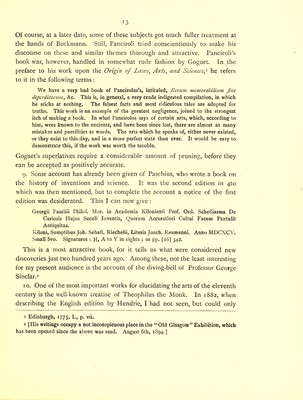
!['I’lien follows, with separate title page, signatures, and pagination, the tract De Inventoribus as follows : Alexandri Sardi Ferrariensis, De Rervm Inventoribvs, Libri Dm lis Maxima, Qvorvm Nvila mentio eft apud Polydorum. In Qvibvs Omnivm fcientiarum, omniumq; fere rerum principium quoddara quam breuiffime continetur. Mogvntire Per Franciscvm Behem, Anno M.D.LXXVII. Small 8°, a to d in eights, e in four, or pp. 64 [5, i blank, 2]. Printed in italics. ai. Title, z'mo is blank. a 2 to d8. Text, pp. 1-64. cX'irecio. Index. At the foot of e 3 is the imprint: Coloniae Agrippinae, Typis Godefridi Kempenfis. e 3 verso is blank, and e 4 (blank ?) is wanting. This book is in the British Museum [802 . b . 9 (i)], the second number in the same volume being, by the way, the rare work of Pastregicus, which I formerly described in detail. I have a copy of the book De reniin inventoribus with that date, and so far as appearances go it might pass of course for a separate publication. If this be the first edition, it is certainly curious that it should have appeared at Mayence. That the work, De Ritibus Gentium^ which was first printed at Venice in 1557, should be reprinted at Mayence is intelligible, but how an unpublished work by the author should be appended to it is not quite so intelligible. One would have expected the first edition of a book by an Italian, which was meant to supplement a work by another Italian, to have appeared somewhere in Italy, in Ferrara most likely, as being the place where the author spent his life; but, if not there, in Venice, where the previous works of both the authors concerned had been printed. There seems, however, to be no good ground for doubting it, if any reliance can be placed on the following. tmoX, De Ritibus, is dedicated to Pope Julius, and the dedication is dated 1557. In the 1577 edition there is another dedication to the same pope, in which it is said that after twenty years the book returns to him once again, only more correct in this German edition than in the former one at Venice, and in order that this iteration may not be distasteful, there is now added by way of novelty a tract on those inventions which were omitted by Polydore. This, therefore, would seem to be actually the first issue of the tract.](https://iiif.wellcomecollection.org/image/b24926905_0025.jp2/full/800%2C/0/default.jpg)



 No text description is available for this image
 No text description is available for this image
 No text description is available for this image