Bibliographical notes on histories of inventions and books of secrets.
- John Ferguson
- Date:
- 1910
Licence: In copyright
Credit: Bibliographical notes on histories of inventions and books of secrets. Source: Wellcome Collection.
Provider: This material has been provided by The University of Glasgow Library. The original may be consulted at The University of Glasgow Library.
26/428 page 10
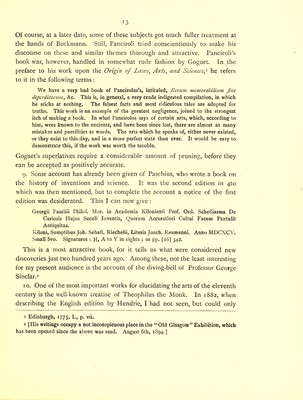
![lO unless the whole thing, preface and all, has been reprinted bodily from an Italian edition of the same or an earlier date, only with the necessary change involved in the adjective “ German.” I have seen no notice of an Italian edition of or prior to 1577, and therefore the Mayence edition may be the first, with Sardi’s actual supervision. This, too, is possible, though remark- able in the case of a man who seems never to have gone from the town where he lived and died. But with regard to these dedications there is something of a hitch. Pope Julius III. bore rule from 1550 to 1555, in which year he died. Although not printed till 1557, the author may have written the dedication before 1555, and may not have seen any need to change it. But how he could re-address it to the same Pope, twenty-two years after his death, not only taking no notice of that fundamental change, but actually saying that to keep him from being bored by the sight of this old book, he had added something new, is a problem for which I have no solution handy. I have found a nearly parallel case in Vigani’s dedication. Is it a way Italians had to dedicate their books to patrons who had been dead for a quarter of a century or so ? This question, I think, has not been discussed by Mr. Wheatley in his book about Dedications to Patron and Friend. 8. Although the History of Inventions^ by Guido Panciroli,^ was originally written in Italian, it first appeared in the Latin version of it, which was made by Heinrich Salmuth.® While, therefore, on the ground of chronology that translation ought to be taken first, it seems more correct to describe the Italian original from which the Latin was presumably translated. It is as follows from the copy in the British Museum, 7955. c. 32 :— Raccolta | Breve | D’Alcvne Cose Piv | fegoalate c’hebbero gli antichi, e d’alcune j altre trouate da moderni. | Opera Dell’ Eccell. S. Dottore | Gvido Panciroli j Da Reggio. I Con I’aggiunta d’alcune conliderationi curiofe, & utili di | Flavio 1 Formerly (Part II. p. 243), I called him Pancicollo, but the tiue form seems to be Panciroli. There are also two incompatible statements on the same page—the first is that I knew no Italian edition of the work ; and then a few lines further on the Italian edition of 1612 is mentioned. What was really meant, though it was so inaccurately expressed, was that I knew no Italian edition prior to 1599, and concluded that Salmuth therefore must have translated from MS. Besides, I had not examined the 1612 edition, and did not know whether it was the original or a retranslation from the Latin, which was not impossible. 2 [See Note on Panciroli’s book at the end of this paper.]](https://iiif.wellcomecollection.org/image/b24926905_0026.jp2/full/800%2C/0/default.jpg)



 No text description is available for this image
 No text description is available for this image
 No text description is available for this image