Bibliographical notes on histories of inventions and books of secrets.
- John Ferguson
- Date:
- 1910
Licence: In copyright
Credit: Bibliographical notes on histories of inventions and books of secrets. Source: Wellcome Collection.
Provider: This material has been provided by The University of Glasgow Library. The original may be consulted at The University of Glasgow Library.
74/428 (page 184)
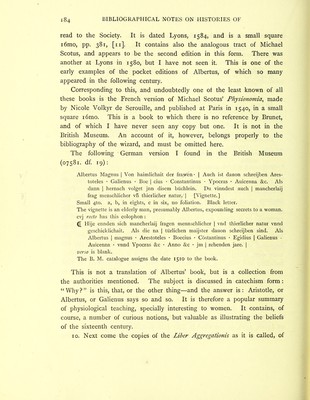
![read to the Society. It is dated Lyons, 1584, and is a small square i6mo, pp. 381, [ii]. It contains also the analogous tract of Michael Scotus, and appears to be the second edition in this form. There was another at Lyons in 1580, but I have not seen it. This is one of the early examples of the pocket editions of Albertus, of which so many appeared in the following century. Corresponding to this, and undoubtedly one of the least known of all these books is the French version of Michael Scotus’ Physionomia, made by Nicole Volkyr de Serouille, and published at Paris in 1540, in a small square i6mo. This is a book to which there is no reference by Brunet, and of which I have never seen any copy but one. It is not in the British Museum. An account of it, however, belongs properly to the bibliography of the wizard, and must be omitted here. The following German version I found in the British Museum (07581. df. 19): Albertus Magnus | Von haimlichait der frawen- | Auch 1st dauon schreijben Ares- toteles • Galienus • Boe | cius • Constantinus ■ Ypocras • Auicenna &c. Als dann | hernach volget jnn disem biichlein. Du vinndest auch | mancherlaij frag menschlicher vn thierlicher natur. | [Vignette.] Small 4to. a, b, in eights, c in six, no foliation. Black letter. The vignette is an elderly man, presumably Albertus, expounding secrets to a woman, cvj recto has this colophon : ([ Hije ennden sich mancherlaij fragen mennschlicher | vnd thierlicher natur vnnd geschicklichait. Als die na | tiirlichen maijster dauon schreijben sind. Als Albertus | magnus • Arestoteles • Boecius • Costantinus • Egidius | Galienus - Auicenna • vnnd Ypocras &c • Anno &c • jm | zehenden jare. | verso is blank. The B. M. catalogue assigns the date 1510 to the book. This is not a translation of Albertus’ book, but is a collection from the authorities mentioned. The subject is discussed in catechism form : “Why?” is this, that, or the other thing—and the answer is: Aristotle, or Albertus, or Galienus says so and so. It is therefore a popular summary of physiological teaching, specially interesting to women. It contains, of course, a number of curious notions, but valuable as illustrating the beliefs of the sixteenth century. 10. Next come the copies of the Liber Aggregationis as it is called, of](https://iiif.wellcomecollection.org/image/b24926905_0074.jp2/full/800%2C/0/default.jpg)