An illustrated introduction to Lamarck's conchology; contained in his Histoire naturelle des animaux sans vertèbres: being a literal translation of the descriptions of the recent and fossil genera / Accompanied by ... plates. By Edmund A. Crouch, F.L.S.
- Edmund A. Crouch
- Date:
- 1826
Licence: Public Domain Mark
Credit: An illustrated introduction to Lamarck's conchology; contained in his Histoire naturelle des animaux sans vertèbres: being a literal translation of the descriptions of the recent and fossil genera / Accompanied by ... plates. By Edmund A. Crouch, F.L.S. Source: Wellcome Collection.
14/112 (page 2)
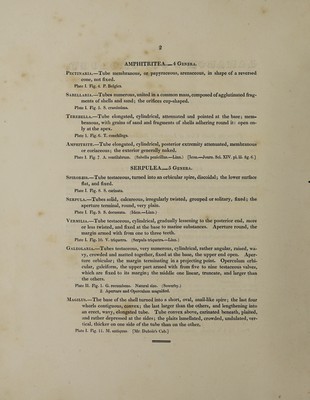
![o AMPHITRITEA..—4 Genera. Pectinaria.—Tube membranous, or papyraceous, arenaceous, in shape of a reversed cone, not fixed. Plate I. Fig. 4. P. Belgica. S abell aria.—Tubes numerous, united in a common mass, composed of agglutinated frag¬ ments of shells and sand; the orifices cup-shaped, Plate I. Fig. 5. S. crassissima. Terebella.—Tube elongated, cylindrical, attenuated and pointed at the base; mem¬ branous, with grains of sand and fragments of shells adhering round it: open on¬ ly at the apex. Plate 1. Fig. 6. T. conchilega. Amphitrite.—Tube elongated, cylindrical, posterior extremity attenuated, membranous or coriaceous; the exterior generally naked. Plate I. Fig. 7- A. ventilabrum. (Sabella penicillus.—Linn.) [Icon.—Journ. Sci. XIV. pl.iii. fig. 6.] SERPULEA._5 Genera. Spirorbis.—Tube testaceous, turned into an orbicular spire, discoidal; the lower surface flat, and fixed. Plate I. Fig. 8. S. carinata. Serpula.—Tubes solid, calcareous, irregularly twisted, grouped or solitary, fixed; the aperture terminal, round, very plain. Plate I. Fig. 9. S. decussata. (Idem.—Linn.) Vermilia.—Tube testaceous, cylindrical, gradually lessening to the posterior end, more or less twisted, and fixed at the base to marine substances. Aperture round, the margin armed with from one to three teeth. Plate I. Fig. 10. V. triquetra. (Serpula triquetra.—Linn.) Galeolaria.—Tubes testaceous, very numerous, cylindrical, rather angular, raised, wa¬ vy, crowded and matted together, fixed at the base, the upper end open. Aper¬ ture orbicular; the margin terminating in a projecting point. Operculum orbi¬ cular, galeiform, the upper part armed with from five to nine testaceous valves, which are fixed to its margin; the middle one linear, truncate, and larger than the others. Plate II. Fig. 1. G. recumbens. Natural size. (Sowerby.) 2. Aperture and Operculum magnified. Magilus.—The base of the shell turned into a short, oval, snail-like spire; the last four whorls contiguous, convex; the last larger than the others, and lengthening into an erect, wavy, elongated tube. Tube convex above, carinated beneath, plaited, and rather depressed at the sides; the plaits lamellated, crowded, undulated, ver¬ tical, thicker on one side of the tube than on the other.](https://iiif.wellcomecollection.org/image/b30451085_0014.jp2/full/800%2C/0/default.jpg)