An illustrated introduction to Lamarck's conchology; contained in his Histoire naturelle des animaux sans vertèbres: being a literal translation of the descriptions of the recent and fossil genera / Accompanied by ... plates. By Edmund A. Crouch, F.L.S.
- Edmund A. Crouch
- Date:
- 1826
Licence: Public Domain Mark
Credit: An illustrated introduction to Lamarck's conchology; contained in his Histoire naturelle des animaux sans vertèbres: being a literal translation of the descriptions of the recent and fossil genera / Accompanied by ... plates. By Edmund A. Crouch, F.L.S. Source: Wellcome Collection.
28/112 (page 16)
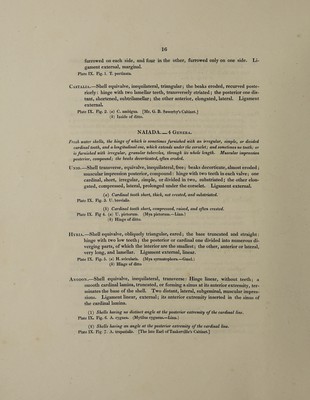
![furrowed on each side, and four in the other, furrowed only on one side. Li¬ gament external, marginal. Plate IX. Fig. 1. T. pectinata. Castalia.—Shell equivalve, inequilateral, triangular; the beaks eroded, recurved poste¬ riorly : hinge with two lamellar teeth, transversely striated; the posterior one dis¬ tant, shortened, subtrilamellar; the other anterior, elongated, lateral. Ligament external. Plate IX. Fig. 2. (a) C. ambigua. [Mr. G. B. Sowerby’s Cabinet.] (b) Inside of ditto. NAIAD A. — 4 Genera. Fresh water shells, the hinge of which is sometimes furnished with an irregular, simple, or divided cardinal tooth, and a longitudinal one, which extends under the corselet; and sometimes no tooth; or is furnished with irregular, granular tubercles, through its whole length. Muscular impression posterior, compound; the beaks decorticated, often eroded. XTnio.—Shell transverse, equivalve, inequilateral, free; beaks decorticate, almost eroded; muscular impression posterior, compound: hinge with two teeth in each valve; one cardinal, short, irregular, simple, or divided in two, substriated; the other elon¬ gated, compressed, lateral, prolonged under the corselet. Ligament external. (a) Cardinal tooth short, thick, not crested, and substriated. Plate IX. Fig. 3. U. brevialis. (b) Cardinal tooth short, compressed, raised, and often crested. Plate IX. Fig 4. (a) U. pietorum. (Mya pictorum.—Linn.) (6) Hinge of ditto. Hyria.—Shell equivalve, obliquely triangular, eared; the base truncated and straight: hinge with two low teeth; the posterior or cardinal one divided into numerous di¬ verging parts, of which the interior are the smallest; the other, anterior or lateral, very long, and lamellar. Ligament external, linear. Plate IX. Fig. 5. (a) H. avicularis. (Mya syrmatophora.—Gmel.) (£>) Hinge of ditto Anodon.—Shell equivalve, inequilateral, transverse: Hinge linear, without teeth; a smooth cardinal lamina, truncated, or forming a sinus at its anterior extremity, ter¬ minates the base of the shell. Two distant, lateral, subgeminal, muscular impres¬ sions. Ligament linear, external; its anterior extremity inserted in the sinus of the cardinal lamina. (1) Shells having no distinct angle at the posterior extremity of the cardinal line. Plate IX. Fig. 6. A. cygnea. (Mytilus cygneus.—Linn.) (2) Shells having an angle at the posterior extremity of the cardinal line. Plate IX. Fig. 7- A. trapezialis. [The late Earl of Tankerville’s Cabinet.]](https://iiif.wellcomecollection.org/image/b30451085_0028.jp2/full/800%2C/0/default.jpg)