An illustrated introduction to Lamarck's conchology; contained in his Histoire naturelle des animaux sans vertèbres: being a literal translation of the descriptions of the recent and fossil genera / Accompanied by ... plates. By Edmund A. Crouch, F.L.S.
- Edmund A. Crouch
- Date:
- 1826
Licence: Public Domain Mark
Credit: An illustrated introduction to Lamarck's conchology; contained in his Histoire naturelle des animaux sans vertèbres: being a literal translation of the descriptions of the recent and fossil genera / Accompanied by ... plates. By Edmund A. Crouch, F.L.S. Source: Wellcome Collection.
32/112 (page 20)
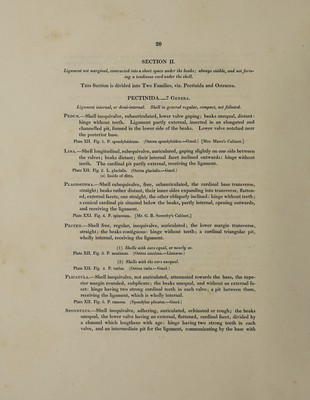
![SECTION II. Ligament not marginal, contracted into a short space under the beaks; always visible, and not form¬ ing a tendinous cord under the shell. This Section is divided into Two Families, viz. Pectinida and Ostracea. PECTINIDA_7 Genera. Ligament internal, or demi-internal. Shell in general regular, compact, not foliated. Pedum.—Shell inequivalve, subauriculated, lower valve gaping; beaks unequal, distant: hinge without teeth. Ligament partly external, inserted in an elongated and channelled pit, formed in the lower side of the beaks. Lower valve notched near the posterior base. Plate XII. Fig. 1. P. spondyloideum. (Ostrea spondyloidea.—“Gmel.) [Mrs. Mawe’s Cabinet.] Li ma.—Shell longitudinal, subequivalve, auriculated, gaping slightly on one side between the valves; beaks distant; their internal facet inclined outwards: hinge without teeth. The cardinal pit partly external, receiving the ligament. Plate XII. Fig. 2. L. glacialis. (Ostrea glacialis.—Gmel.) («) Inside of ditto. Plagiostoma.—Shell subequivalve, free, subauriculated, the cardinal base transverse, straight; beaks rather distant, their inner sides expanding into transverse, flatten¬ ed, external facets, one straight, the other obliquely inclined: hinge without teeth ; a conical cardinal pit situated below the beaks, partly internal, opening outwards, and receiving the ligament. Plate XXI. Fig. 4. P. spinosum. [Mr. G. B. Sowerby’s Cabinet.] Pecten.—Shell free, regular, inequivalve, auriculated; the lower margin transverse, straight; the beaks contiguous: hinge without teeth; a cardinal triangular pit, wholly internal, receiving the ligament. (1) Shells with ears equal, or nearly so. Plate XII. Fig. 3. P. maximus. (Ostrea maxima.—Linnaeus.) (2) Shells with the ears unequal. Plate XII. Fig. 4. P. varius. (Ostrea varia.— Gmel.) Plicatula.—Shell inequivalve, not auriculated, attenuated towards the base, the supe¬ rior margin rounded, subplicate; the beaks unequal, and without an external fa¬ cet: hinge having two strong cardinal teeth in each valve; a pit between them, receiving the ligament, which is wholly internal. Plate XII. Fig. 5. P. ramosa. (Spondylus plicatus.—Gmel.) - < Spondylus.—Shell inequivalve, adhering, auriculated, echinated or rough; the beaks unequal, the lower valve having an external, flattened, cardinal facet, divided by a channel which lengthens with age: hinge having two strong teeth in each valve, and an intermediate pit for the ligament, communicating by the base with](https://iiif.wellcomecollection.org/image/b30451085_0032.jp2/full/800%2C/0/default.jpg)