An illustrated introduction to Lamarck's conchology; contained in his Histoire naturelle des animaux sans vertèbres: being a literal translation of the descriptions of the recent and fossil genera / Accompanied by ... plates. By Edmund A. Crouch, F.L.S.
- Edmund A. Crouch
- Date:
- 1826
Licence: Public Domain Mark
Credit: An illustrated introduction to Lamarck's conchology; contained in his Histoire naturelle des animaux sans vertèbres: being a literal translation of the descriptions of the recent and fossil genera / Accompanied by ... plates. By Edmund A. Crouch, F.L.S. Source: Wellcome Collection.
33/112 (page 21)
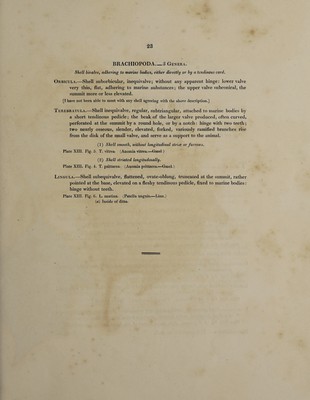
![the external channel. Ligament internal; the remains of former ligaments are seen outside in the channel. Plate XII. Fig. 6. S. gaederopus. (Idem.—Linn.) Podopsis.—Shell inequivalve, subregular, adhering by the inferior beak, not auriculated, the lower valve largest, most convex, and the beak most produced: hinge without teeth. Ligament internal. Plate XXI. Fig. 5. P. truncata. Fossil. [Icon.—Encyc. Method. PI. 188. Fig. 6.] OSTRACEA_5 Genera. Ligament internal, or demi-internal. Shell irregular, foliated, sometimes very thin. This Family is separated into Two Divisions. (a) Ligament demi-internal. Shell foliated, and often very thick. Grypii^a.—Shell free, inequivalve, the lower valve large, concave, terminated by a pro¬ jecting involute beak, the upper valve small, flat, and opercular: hinge without teeth; an oblong, arched cardinal pit; only one muscular impression in each valve. Plate XII. Fig..7- G. angulata. Ostrea.—Shell adhering, inequivalve, irregular; beaks distant, becoming very unequal by age, and the upper valve gradually removed during the life of the animal: hinge without teeth. Ligament demi-internal, inserted in the cardinal pit of the valves; the pit of the lower valve increasing by age, sometimes to a great length. (1) Margin of the valves simple or wavy, not plicate. Plate XII. Fig. 8. O. edulis. (Idem.—Linn.) (2) Margin of the shells distinctly plaited. Plate XII. Fig. 9. O. folium. (Idem.—Linn.) Vulsella.—Shell longitudinal, subequivalve, irregular, free; the beaks equal: hinge with a prominent callosity in each valve, depressed above, shewing an impression of a conical and obliquely arched pit for the ligament. Plate XII. Fig. 10. V. lingulata. (Mya vulsella.—Linn.) (b) Ligament internal. Shell thin, papyraceous. Placuna.—Shell free, irregular, flat, subequivalve: hinge internal, having two sharp longitudinal ribs in one valve, approximate at their base, and diverging in form of a V; and, in the other valve, two impressions which correspond with the cardinal ribs; to which is attached the ligament. Plate XII. Fig. 13. P. placenta. (Anomia placenta.—Linn.) Anomia.—Shell inequivalve, irregular, operculated, adhering by the operculum: lower valve perforated, generally flattened, having a hole or channel at the beak; the other valve rather larger, concave, entire. Operculum small, elliptical, osseous, fixed to marine substances. Plate XIII. Fig. 1. A. ephippium. (Idem.—Linn.) (a) Operculum of ditto.](https://iiif.wellcomecollection.org/image/b30451085_0033.jp2/full/800%2C/0/default.jpg)