Rest and pain : a course of lectures on the influence of mechanical and physiological rest in the treatment of accidents and surgical diseases, and the diagnostic value of pain / by John Hilton ; edited by W.H.A. Jacobson.
- Date:
- 1892
Licence: Public Domain Mark
Credit: Rest and pain : a course of lectures on the influence of mechanical and physiological rest in the treatment of accidents and surgical diseases, and the diagnostic value of pain / by John Hilton ; edited by W.H.A. Jacobson. Source: Wellcome Collection.
Provider: This material has been provided by the Royal College of Physicians of Edinburgh. The original may be consulted at the Royal College of Physicians of Edinburgh.
103/538
![nected 'with derangements of the internal viscera, are of great and pressing interest to ns. 1 conceive that pains situated upon the surface of the body, and associated with some abnormal state of an internal viscus, must be looked upon as a beneficent provision, enabling us by external pain to receive the information and to appreciate slight organic changes or derangements of function of the internal viscera.* Otherwise, and without some such reference, it seems difficult to understand why there should be structural nervous communication, and thence pain, upon any part of the surface of the body, consequent upon the patho- logical state of internal viscera or internal parts of the body. Perhaps one of the most frequent of the “ sympathetic ”f the 3rd and 4th cervical and also tending twigs to the porta of the liver and to the round ligament; that again of Prof. Rolleston, who explained (Address on Physiology, 1868) this pain by the connection between the phrenic nerve and that to the subclavius. Dr. Embleton, however, believes that this pain originates in the filaments of the vagus which reach the hepatic plexuses, and that then by the intimate connec- tion between the vagus and the spinal-accessory it is expressed in the branches of tlie latter which supply the trapezius and which communicate beneath it with the third and fourth cervical nerves. Dr. Embleton gives the following as his reasons for thinking that this liver pain is connected with the vagus rather than with the phrenic, viz. that its ordinary seat is not in the clavicle, but in the edge of the trapezius rather than in the clavicle, and that the trunks of the vagus and the outer division of the spinal-accessory, as far as they are amenable to examination, are abnor- mally sensitive to pressure.—[Eu.] * For two theories of the use of these “ sympathetic ” pains see a paper by Dr. Hart (Pract. vol. xxi. p. 346) to which fuller reference is made. Lect. ix. note p. 210.—[Ed.] t The subject of dorso-intercostal pain, especially that variety known as infra-mammary, will bo found discussed in the pages of the Brit. Med. Journ. for 1858. Dr. Martyn (Brit. Med. Journ. vol. ii. 1864) gives the following explanation, which, like that of Mr. Hilton, is based on the connection between the sympathetic and spinal nerves. “ The question was this :—Why is pain almost invariably confined to the 6th, 7th, and 8th intercostal spaces of the left side ? The answer seems to be a relation to the heart The aortic arch impinges on the left side of the 3rd dorsal vertebra, and opposite the 4th, 5th, and 6th, it receives contributions to its plexus from the corresponding ganglia of the sympathetic, while its plexus again contributes to the heart. These sympathetic ganglia have, however, just received branches from the intercostal nerves themselves: and so it is that the heart and theintor- G 2](https://iiif.wellcomecollection.org/image/b21972412_0103.jp2/full/800%2C/0/default.jpg)
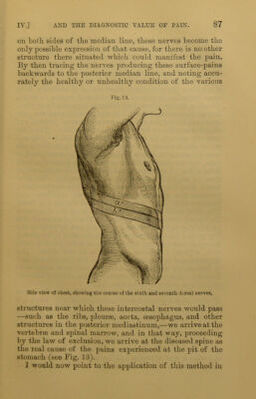
 No text description is available for this image
 No text description is available for this image
 No text description is available for this image