Rest and pain : a course of lectures on the influence of mechanical and physiological rest in the treatment of accidents and surgical diseases, and the diagnostic value of pain / by John Hilton ; edited by W.H.A. Jacobson.
- Date:
- 1892
Licence: Public Domain Mark
Credit: Rest and pain : a course of lectures on the influence of mechanical and physiological rest in the treatment of accidents and surgical diseases, and the diagnostic value of pain / by John Hilton ; edited by W.H.A. Jacobson. Source: Wellcome Collection.
Provider: This material has been provided by the Royal College of Physicians of Edinburgh. The original may be consulted at the Royal College of Physicians of Edinburgh.
106/538
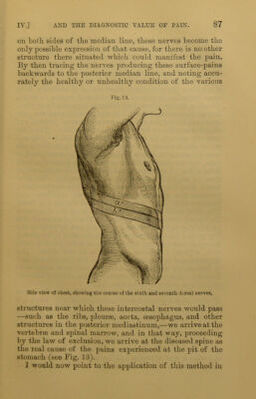
![the intervertebral substance—I think upon the whole, most frequently in the intervertebral substance, or where this is joined to the vertebra.* This rather supports the view that diseases of the spine are very often the result of accident, because we know that in accidents, at least so far as I have been able to discover, the most frequent lesion or injury to the spine is a partial severance of the vertebra from the intervertebral substance; and I suspect the same thing obtains with respect to disease of the spine. The pain associated with diseased spine to which I now refer is found upon the skin supplied by the nerves which escape from the vertebral canal through the intervertebral foramina, close to the bones or intervertebral substances, either of which, as I have said, may be the seat of the disease. It is upon the recognition and right interpreta- tion of the cause of this pain upon the surface of the body that we ought to place the best prospect of early and cor- rect diagnosis in spinal disease. In disease of the lower cervical, dorsal, and lumbar regions of the vertebral column, the pain is usually ex- pressed symmetrically—that is, on both sides alike. It is often, however, not so when the disease lies between the occiput and atlas, or between the first and second cervical vertebrae. In all cases of symmetrical pains the cause is central or double, both sides being in a like morbid con- dition, whatever the disease may be. I have had this sketch (Fig. 13) made for the purpose of reminding you of the method of proceeding in analysing the cause of sym- metrical pains. I will select two of the dorsal nerves for the purpose of illustration. The positions of the sixth and seventh dorsal nerves are here indicated, as they are distributed to the skin just over the pit of the stomach. If pain be felt at that part alike * This view, that disease of the spine commences at the junction of the vertebra? with the intervertebral substances more frequently than in the intervertebral substances or the vertebra? themselves, receives support from the fact that the junction of a more to a less elastic body is the weakest spot, and therefore receives the full effect of a strain. In a somewhat similar manner, aneurisms so commonly commence at the junction of an atheromatous with the healthy part of an artery ; such a spot, with its sudden diminution of elasticity, being naturally unfitted to meet either a strain or increased blood-pressure.—[Ed.]](https://iiif.wellcomecollection.org/image/b21972412_0106.jp2/full/800%2C/0/default.jpg)
 No text description is available for this image
 No text description is available for this image
 No text description is available for this image