Volume 1
The universal dictionary of biography and mythology / by J. Thomas.
- Joseph Thomas
- Date:
- [1887]
Licence: Public Domain Mark
Credit: The universal dictionary of biography and mythology / by J. Thomas. Source: Wellcome Collection.
641/646 (page 627)
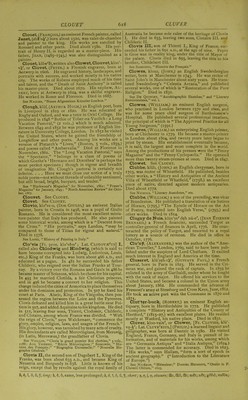
![Clodius, (Johann Christian,) a German Orien- talist, who became professor of Arabic at Leipsic in 1724. He published a work on the Arabic language, entitled “ Theoria et Praxis Lingua: Arabicae,” and a “ Hebrew Lexicon,” (1744.) Died in 1745. Clodius, (Juliana Stolzel,) the wife of Christian August, noticed above, born at Altenburg in 1755, was eminent for her literary talents and attainments. Died in 1805. Clo'dI-us, (Licinius,) a Roman historian, who lived probably about 100 B.C., wrote a work called Eteyx°C Xpuvuv, (“Trial of the Times.”) Clodius, (Publius,) surnamed Pul'cher, a Roman demagogue of very profligate character, was descended from the patrician house of Claudia, and was a brother of Appius Claudius Pulcher, noticed in this work. In his youth he served in Asia under Lucullus, his brother- in-law. In 62 B.c. he committed an act of sacrilege by procuring admission to the mysteries of Bona Dea in the disguise of a woman. For this he was tried, but ac- quitted by means of bribery; and he became a violent enemy of Cicero, who had appeared in evidence against him. He was chosen tribune of the people in 59, and in the next year caused Cicero to be proscribed and driven into exile. (See Cicero.) He raised several bloody riots against the friends of Cicero when they proposed and passed the decree for his restoration, 57 B.C. Milo, who succeeded Clodius as tribune, and was a partisan of Cicero, had several conflicts with the former. While Clodius was a candidate for the pra:torship, and Milo for the consulship, they casually encountered each other with their armed retainers, and Clodius was killed, in the-year 52 b.c. See Cicero, “Oratio pro Milone;” Drumann, “Gcschichte Roms.” Clo'dI-us Ma'cer, (Lucius,) a Roman general, who, on the death of Nero, raised the standard of revolt in Africa, and aspired to the power of emperor. Pie was put to death by order of Galba in 68 A.D. Clo'do-mir, [Fr. pron. klo'do'mfeR', ] the second son of Clovis, King of the Franks, became King of Orleans in 511 A.D. He was killed in battle with the Burgundians in 524. He left three sons, two of whom were put to death by their uncles, and the third, Clodoald (Saint- Cloud,) became a monk. Clodovaeus. See Clovis. Clodwig. See Clovis. Clonard, de, deh klohiait', (Joseph Ernest,) a French dramatist, born in 1765, wrote numerous come- dies. Died in 1816. Clon-ciiiTy, (Valentine Lawless,) Lord, an Irish politician, born at Dublin in 1773, was a member of the Society of United Irishmen, and a friend of Emmet and Grattan. He wrote “Thoughts on the Projected Union between Great Britain and Ireland,” (1797.) Died in 1853. See “Personal Recollections of the Life and Times of Lord Cion- curry.” Clootz, de, d?h klots, (Anacharsis,) Baron, a Prus- sian enthusiast, born near Cleves in 1755, was a nephew of Cornelius de Pauw. Having inherited a large fortune, he became a resident of Paris, and a fanatical partisan of the Revolution. Assuming the title of the “ orator of the human race,” he appeared at the bar of the Assembly in 1790, at the head of a pretended deputation from foreign nations. In 1792 he was elected to the Con- vention by the dominant party. He was proscribed by Robespierre, and executed in March, 1794. See “ Nouvelle Biographie Gendrale“Biographie Universelle.” Clopinel. See Meun. Cloquet, klo'kV, (Hippolyte,) a distinguished pro- fessor of anatomy, was born in Paris in 1787. He wrote, besides other works, a “Treatise on Descriptive Ana- tomy,” (1815.) Died about 1840. Cloquet, (Jules Germain,) an eminent French phy- sician and surgeon, a brother of the preceding, was bom in Paris in 1790. In 1831 he was appointed pro- fessor of clinical surgery in the Faculty of Paris. He wiote “ Human Anatomy,” (“ Anatomiede ITiomme,” S vols., 1821-30,) and other professional works. He was elected a member of the Institute in 1855* Died Clos. See Laclos. Close, (Francis,) an eloquent English preacher, born about 1798, was for many years vicar of Cheltenham. He published “Discourses on Genesis,” (1826,) several volumes of sermons, and other works, which maintain the doctrines of the Evangelical school. Pie was ap- pointed to the deanery of Carlisle about 1856. Closs, klos, or Clossius, klos'se-hs, (Johann Fried- rich,) a German physician and poet, born at Marbaeh in 1735. He wrote several Latin poems on medical subjects. Died in 1787. Closteriuan, Mos'ler-mHit', (Johann,) a German portrait-painter, born at Osnaburg in 1656, worked in England. Died in London in 1710. Closterniami. See Klostermann. Clot, klo, or Clot-Bey, klo l>.\, (Antoine,) a French physician, born near Marseilles about 1796. He became chief surgeon of Mehemet Ali, Viceroy of Egypt, about 1823, and founded a medical school in that country. He published “ Observations on Egypt,” (2 vols., 1840.) In 1849 he returned to France. Died in 1868. See “ Foreign Quarterly Review” for July, 1841. Clot-Bey. See Clot, (Antoine.) Clotaire, klo'tSR', [Lat. Clota'rius,] I., the fourth son of Clovis, King of the Franks, was born in 497 a.d. At the death of Clovis, in 511, he became King of Sois- sons. He extended his dominions by murdering his nephews, the heirs of the kingdoms of Orleans and Austrasia, and before his death he became ruler over all the territory which Clovis had divided among his sons. Paris was his capital after 558. He died about 560 A.D., leaving four sons,—Caribert, Gontran, Sigebert, and Chilperic I. See Jean Bouchet, “ Histoire et Chronique de Clotaire I,” 1584: Sismondi, “Histoire des Franjais.” Clotaire II., the son of Chilperic I. and of Frede- gonde, was an infant when he became heir to the king- dom of Soissons in 584 a.d. His mother was regent until her death in 597. By dethroning Brunehaut, Queen of Austrasia, whom, with her sons, he put to death, he made himself master of all France about 615. He was the first who conceded to the mayor of the palace a ten- ure of office for life. His abilities and success procured him the surname of “the Great.” He died in 628, and was succeeded by his son Dagobcrt. See Sismondi, “Histoire des Franpais.” Clotaire III., the eldest son of Clovis II., King of the Franks, was a minor when his father died, in 655 a.d. ; and, the kingdom being divided into two portions, he inherited Neustria and Burgundy. He died, without issue, about the age of eighteen. Clotaire IV., King of Austrasia, was raised to the throne in 717 a.d. by the policy of Charles Martel, but was only a nominal king. It is not known who was his father. Died in 720. See Augustin Thierry, “Rdcits Merovingiens.” Clotho. See Parc/E. Clo-til'da, [Fr. Clotilde, klo'ttld',] Saint, Queen of France, the daughter of Chilperic, King of Burgundy, became the wife of Clovis I. in 493 a.d. By her beauty and virtue she acquired much influence over Clovis, and was instrumental in converting him to the profession of Christianity. She adhered to the Catholic creed in opposition to Arianism, which was then very prevalent. Died in 545. See Rf.naud de Rouvrav, “ Histoire de Sainte-Clotilde,” 1840; J. Desmay, “Viede Sainte-Clotilde,” 1613; Madame dk Ren,Ne- ville, “Viede Sainte-Clotilde,” 1809. Clotilde. See Clotilda. Clotilde de Vallon-Chalis. See Surville. Clotz. See Klotz. Cloud, kloo, or Clo'do-ald, Saint, youngest son of Clodomir, became an ecclesiastic, and founded a monas- tery at Nogent-sur-la-Riviere, since called by his name. Died about 560. Clouet, kloo'V, an able French chemist, born at Singly, near Mezitres, in 1751, became professor of chemistry at Mezieres. He discovered the important secret of making cast steel, which the English had found out before. Having gone to Cayenne to make some scientific inquiries, he died of fever in 1801. (gj^Sec Explanations, p. 23.) in 1883.](https://iiif.wellcomecollection.org/image/b24878352_0001_0643.jp2/full/800%2C/0/default.jpg)