Studies on the proteids of rye and barley and on the chemical nature of diastase.
- Thomas Burr Osborne
- Date:
- [1893]
Licence: Public Domain Mark
Credit: Studies on the proteids of rye and barley and on the chemical nature of diastase. Source: Wellcome Collection.
Provider: This material has been provided by The Royal College of Surgeons of England. The original may be consulted at The Royal College of Surgeons of England.
3/64 page 147
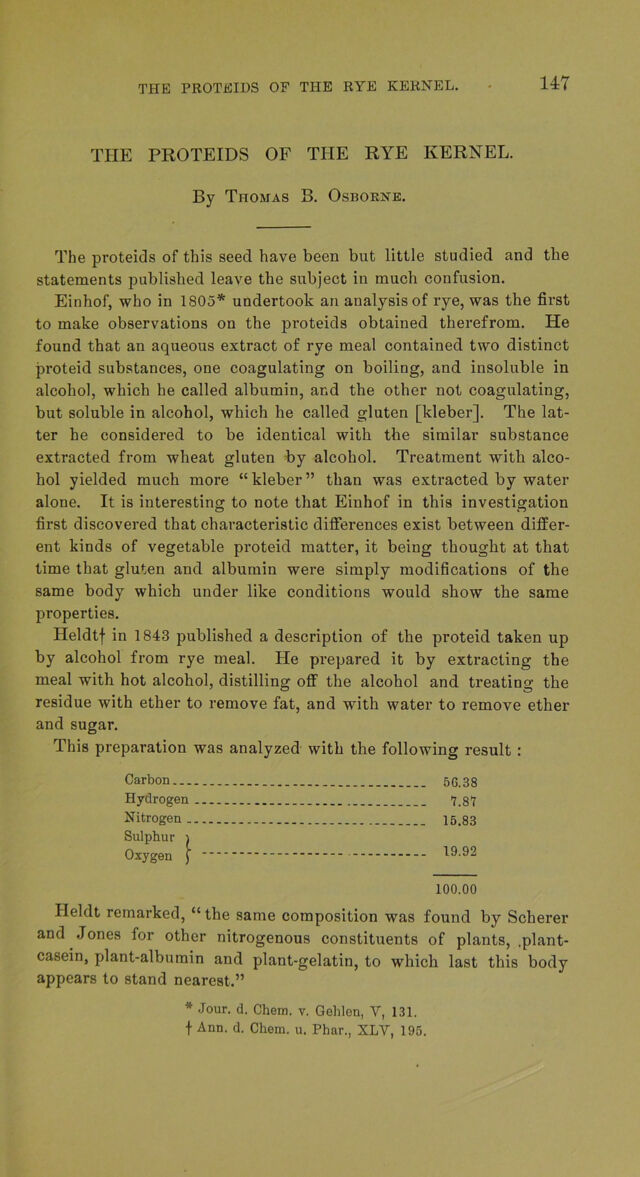
![THE PROTEIDS OF THE RYE KERNEL. By Thomas B. Osborne. The proteids of this seed have been but little studied and the statements published leave the subject in much confusion. Einhof, who in 1805* undertook an analysis of rye, was the first to make observations on the proteids obtained therefrom. He found that an aqueous extract of rye meal contained two distinct proteid substances, one coagulating on boiling, and insoluble in alcohol, which he called albumin, and the other not coagulating, but soluble in alcohol, which he called gluten [kleber]. The lat- ter he considered to be identical with the similar substance extracted from wheat gluten by alcohol. Treatment with alco- hol yielded much more “ kleber ” than was extracted by water alone. It is interesting to note that Einhof in this investigation first discovered that characteristic differences exist between differ- ent kinds of vegetable proteid matter, it being thought at that time that gluten and albumin were simply modihcations of the same body which under like conditions would show the same properties. Heldtf in 1843 published a description of the proteid taken up by alcohol from rye meal. He prepared it by extracting the meal with hot alcohol, distilling off the alcohol and treating the residue with ether to remove fat, and with water to remove ether and sugar. This preparation was analyzed with the following result: Carbon 56.38 Hydrogen 7.87 Nitrogen 15.83 Sulphur ) Oxygen [ - t9.92 100.00 Heldt remarked, “the same composition was found by Scherer and Jones for other nitrogenous constituents of plants, .plant- casein, plant-albumin and plant-gelatin, to which last this body appears to stand nearest.” * Jour. d. Chem. v. Gehlen, V, 131. t Ann. d. Chem. u. Phar., XLV, 195.](https://iiif.wellcomecollection.org/image/b22469771_0005.jp2/full/800%2C/0/default.jpg)