Studies on the proteids of rye and barley and on the chemical nature of diastase.
- Thomas Burr Osborne
- Date:
- [1893]
Licence: Public Domain Mark
Credit: Studies on the proteids of rye and barley and on the chemical nature of diastase. Source: Wellcome Collection.
Provider: This material has been provided by The Royal College of Surgeons of England. The original may be consulted at The Royal College of Surgeons of England.
56/64 page 200
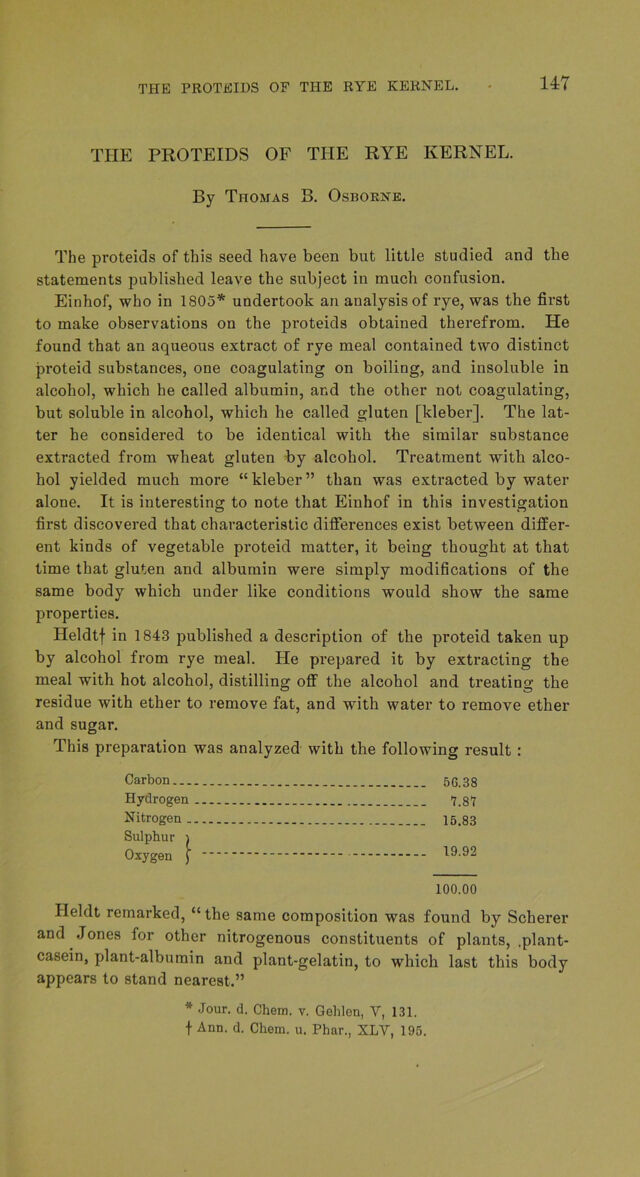
![for 24 hours. A quantity of absolute alcohol was finally added to the contents of the dialyzer, thus completely precipitating the proteid. This preparation after drying was almost wholly solu- ble in water, and when heated slowly its solution became turbid at 60° and deposited flocks at 66°. The amount of proteid thus coagulated was somewhat greater than was given by preparation 6, and its diastatic power was likewise greater, being 75. Analy- sis showed its composition to be as follows: Preparatiox 9. Ash-free. Carbon 53.19 Hydrogen 6.71 Nitrogen 16.74 Sulphur 1.38 Oxygen 21.98 100.00 Ash 0.78 This preparation contained a slight amount of insoluble matter, some albumin and much proteose. The residue of precipitate II, which was not dissolved by water, was treated with sodium chloride solution and the clear extract dialyzed till free from chlorides, but as no precijiitate was produced, the dialyzer was transferred to alcohol when prepara- tion 10 separated, weighing 0.49 gram, and containing, ash-free, 15.18 per cent, of nitrogen. It is probable that this is the same globulin obtained in larger quantity from precipitate I, but less pure. That part of precipitate II which remained undissolved after extracting with water and salt solution, was then washed thoroughly]with water and with alcohol, yielding preparation 11^ which weighed 5.0 grams and had the following composition: Preparation 11. Ash-free. Carbon - 53.51 Hydrogen 6.75 Nitrogen 15.76 Sulphur. 1.12 Oxygen 22.86 100.00 Ash 0.66 These figures show that precipitate II contained less globulin and proportionately more leucosin and proteose than precipitate I and it was accordingly found to be more powerfully diastatic.](https://iiif.wellcomecollection.org/image/b22469771_0058.jp2/full/800%2C/0/default.jpg)