Myopia (commonly called near-sightedness,) in its various phases / by Julian J. Chisholm.
- Julian John Chisolm
- Date:
- [1880]
Licence: Public Domain Mark
Credit: Myopia (commonly called near-sightedness,) in its various phases / by Julian J. Chisholm. Source: Wellcome Collection.
Provider: This material has been provided by The Royal College of Surgeons of England. The original may be consulted at The Royal College of Surgeons of England.
3/34
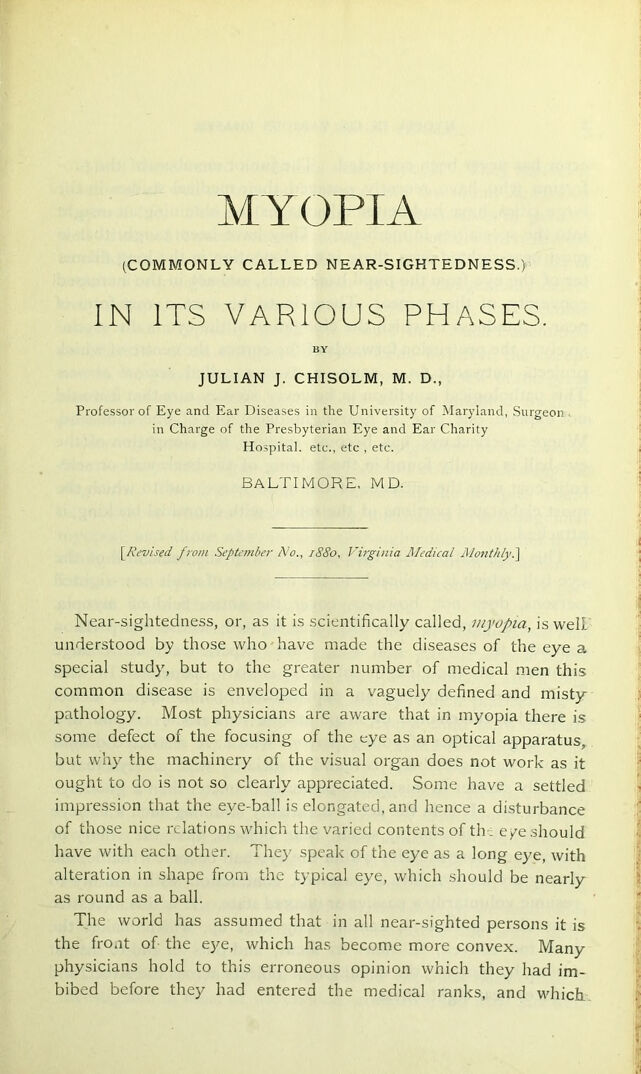
![(COMMONLY CALLED NEAR-SIGHTEDNESS.) IN ITS VARIOUS PHASES. BY JULIAN J. CHISOLM, M. D., Professor of Eye and Ear Diseases in the University of Maryland, Surgeon in Charge of the Presbyterian Eye and Ear Charity Hospital, etc., etc , etc. BALTIMORE, MD. \Revised from September /Vo., 1880, Virginia Medical Monthly.] Near-sightedness, or, as it is scientifically called, myopia, is well understood by those who have made the diseases of the eye a special study, but to the greater number of medical men this common disease is enveloped in a vaguely defined and misty pathology. Most physicians are aware that in myopia there is some defect of the focusing of the eye as an optical apparatus, but why the machinery of the visual organ does not work as it ought to do is not so clearly appreciated. Some have a settled impression that the eye-ball is elongated, and hence a disturbance of those nice relations which the varied contents of th : eye should have with each other. They speak of the eye as a long eye, with alteration in shape from the typical eye, which should be nearly as round as a ball. The world has assumed that in all near-sighted persons it is the front of the eye, which has become more convex. Many physicians hold to this erroneous opinion which they had im- bibed before they had entered the medical ranks, and which](https://iiif.wellcomecollection.org/image/b22398703_0005.jp2/full/800%2C/0/default.jpg)