Licence: Public Domain Mark
Credit: Sales catalogue 502: Maggs Bros. Source: Wellcome Collection.
47/908 page 35
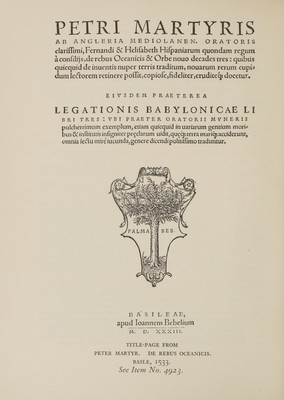
![1533 A.D. [4923] MARTYR (Peter). De rebus Oceanicis & Orbe Novo decades tres: quibus quicquid de inventis nuper terris traditum, novarum rerum cupidum lectorem retinere possit, copiose, fideliter, eruditeque docetur. Ejusdem Legationis Baby- lomeae Libri l'res. Folio, half morocco, g.e. Basle, Joannes Bebelius, 1533. (SEE ILLUsTRATION, OVERLEAF). £35 Harrisse B.A.V. No. 176. Church Catalogue No. 65. Sabin No. 1557. Medina Vol. I, No. 92. John Carter Brown Library Catalogue, Vol. I, p. 108. This work contains the first three Decades and an abridgment of the Fourth, containing the discoveries of Columbus, Vespucius and Cabot, and new discoveries by Cortes. The Church Catalogue could only mention three further copies (British Museum, John Carter Brown, and Lenox Libraries). Pietro Martire d’Anghiera, better known by his Latinized name Petrus Martyr, the first historian of America, was born at Arona, in July, about 1455, and died at Granada, in Spain, in 1526. He possessed eminent ability and learning, and is believed to have been the first Italian writer to notice in hig works the dis- covery of America by his countryman Columbus, as he is the first who published a treatise descriptive of the peculiarities of the natives of the New World. In 1483 he went to Rome, where he became acquainted with Cardinal Ascanio Sforza and Pom- ponius Laetus, to both of whom many of his letters were addressed. He was ex- tremely fond of letter-writing, and, it was owing to him that the news of Columbus’s discovery became speedily known to a number of people outside of Spain. In 1494 he was ordained a priest and appointed as tutor to the children of Ferdinand and Isabella. Seven years later he was sent on a diplomatic mission to Egypt, an account of which he has given us in his Legatio Babylonica, printed at end of above work. He was the friend and contemporary of Columbus, Vasco da Gama, Cortés, Magellan, Cabot, and Vespuccius. From personal contact with these discoverers, as well as from his official position as a member of the Council for the Indies, which afforded him the free inspection of documents of undoubted authenticity, he was enabled to obtain, at first-hand, much valuable information regarding the dis- coveries made by the early navigators. These facts he embodied in his Decades, which were based upon his extensive correspondence, but were written with more care and give more ample details. His works were held in highest esteem by his contemporaries and have always been placed in the highest rank of authorities on the history of the first association of the Indians with the Europeans, and are indis- pensable as a primary source for the history of early American discoveries.](https://iiif.wellcomecollection.org/image/b31641295_0047.jp2/full/800%2C/0/default.jpg)
 No text description is available for this image
 No text description is available for this image
 No text description is available for this image