Further review of certain persistent organochlorine pesticides used in Great Britain.
- Great Britain. Advisory Committee on Pesticides and Other Toxic Chemicals
- Date:
- 1969
Licence: Public Domain Mark
Credit: Further review of certain persistent organochlorine pesticides used in Great Britain. Source: Wellcome Collection.
103/156 page 97
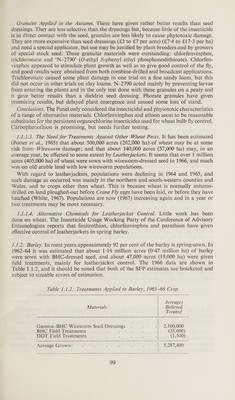
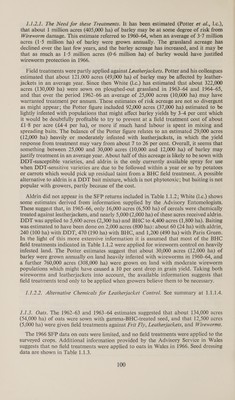
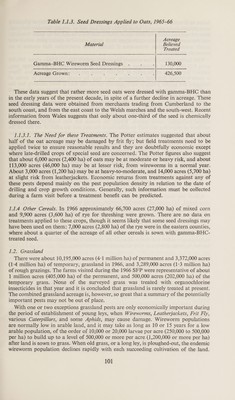
![—such as nicotine—which have been used to control aphids as distinct from other pests and the phrase ‘organophosphorus aphid sprays’ in many of the present tabulations should not be construed purely in terms of a swing away from the organo- chlorines. In some cases—for example in sections 2.2 and 2.3—it has been possible to separate the organophosphorus treatments into those applied against aphids (substi- tuting in part for DDT and BHC), and those applied against other pests which, until recently, would have been routinely dealt with by organochlorine treatments. Secondly, an attempt has been made to discuss the pests against which treatments have been applied, the need to apply the treatments, and the existence or otherwise of experimentally verified alternative chemicals. Non-chemical control methods are not discussed. Thirdly, a summary of organochlorine insecticide usage on Forestry Commission woodlands is included. A survey of usage on privately owned woodlands is in hand but the results are not yet available. In the pages which follow the tabulations refer to England and Wales only. In a few cases data were available from more than one source: in these cases the most reliable data have been set out in tabular form and the other data are discussed textually. 1. FARM CROPS ‘Farm Crops’ are taken here to include those crops which are usually grown by arable and stock farmers as distinct from specialist vegetable, fruit or flower growers. The crops considered under this heading include cereals, grassland, roots, potatoes, legumes, and brassicae for stockfeed. In 1966 these crops were grown on 27 million acres (10-9 million ha) in England and Wales, of which 10-2 million acres (4-1 million ha) were under permanent grass and 3-3 million acres (1:3 million ha) were in rough grazings; excluding grass, annual farm crops covered approximately 10-4 million acres (4-2 million ha) of which almost exactly 8 million (3-2 million ha) were in cereals. 1.1 Cereal Crops Mainly barley (5.29 million acres [2:14 million ha] in 1966), wheat (2-17 million acres {0-88 million ha]) and oats (0-43 million acres [0-17 million ha]). Mixed corn and rye were grown on less than 0-08 million acres (0-03 million ha), half in Wales and the south-western counties. From a pest control viewpoint wheat is the most important cereal and is discussed first. 1.1.1. Wheat. In most years about 77 per cent of the wheat is winter-sown, though in the eastern counties there are areas where over 80 per cent is winter-sown. In 1962-64, when 2:1 million acres (0-8 million ha) of wheat were grown each year, it was estimated (Strickland, 1965) that about 103,000 acres (42,000 ha) were sown with aldrin- or dieldrin-dressed seed, 88,000 acres (36,000 ha) were sown with heptachlor-dressed seed (1962 and 1963), and 702,000 acres (284,000 ha) were sown with BHC-dressed seed. Insecticides applied to the soil or to standing crops included an estimated (and possibly exaggerated) 41,000 acres (16,000 ha) with aldrin and dieldrin, about 12,000 acres (5,000 ha) with BHC, and nearly 6,000 acres (2,500 ha) with DDT. Data are available for the 1965-66 cropping season from the 1966 Survey of Fertiliser Practice (SFP), and from detailed returns made by Seed Merchants to the Plant Pathology Laboratory. In considering these data (Table 1.1.1) it should be noted that SFP estimates are reliable when they relate to more than about 2 per cent of the surveyed crops; in some cases pesticides were used on less than 2 per cent of the crops and the associated errors of estimation increase rapidly as the percentages decline. For example, the 1966 SFP estimate for wheat was that 0-3+0-28 per cent of the acreage was treated with aldrin, giving a mean value of 6,700 acres (2,700 ha) with confidence limits of 2,000 and 15,000 acres (800 and 6,000 ha).](https://iiif.wellcomecollection.org/image/b32173076_0103.jp2/full/800%2C/0/default.jpg)