Further review of certain persistent organochlorine pesticides used in Great Britain.
- Great Britain. Advisory Committee on Pesticides and Other Toxic Chemicals
- Date:
- 1969
Licence: Public Domain Mark
Credit: Further review of certain persistent organochlorine pesticides used in Great Britain. Source: Wellcome Collection.
109/156 page 103
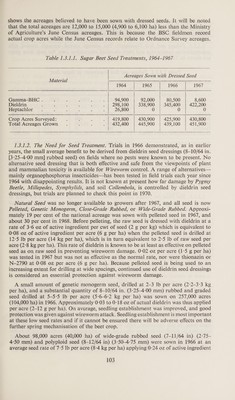
![shows the acreages believed to have been sown with dressed seeds. It will be noted that the total acreages are 12,000 to 15,000 (4,900 to 6,100 ha) less than the Ministry of Agricuiture’s June Census acreages. This is because the BSC fieldmen record actual crop acres while the June Census records relate to Ordnance Survey acreages. Table 1.3.1.1. Sugar Beet Seed Treatments, 1964-1967 Acreages Sown with Dressed Seed Material 1964 1965 1966 1967 Gamma-BHC . : F ; ‘ ; 94,900 92,000 80,500 8,600 Dieldrin : : , : ; . | 298,100 338,900 345,400 422,200 Heptachlor. : : d : : 26,800 0 0 0 Crop Acres Surveyed: : : : . | 419,800 430,900 425,900 430,800 Total Acreages Grown 3 : . | 432,400 445,900 439,100 451,900 1.3.1.2. The Need for Seed Treatment. Trials in 1966 demonstrated, as in earlier years, the small average benefit to be derived from dieldrin seed dressings (8—10/64 in. [3:25-4:00 mm] rubbed seed) on fields where no pests were known to be present. No alternative seed dressing that is both effective and safe from the viewpoints of pliant and mammalian toxicity is available for Wireworm control. A range of alternatives— mainly organophosphorus insecticides—has been tested in field trials each year since 1964 with disappointing results. It is not known at present how far damage by Pygmy Beetle, Millepedes, Symphylids, and soil Collembola, is controlled by dieldrin seed dressings, but trials are planned to check this point in 1970. Natural Seed was no longer available to growers after 1967, and all seed is now Pelleted, Genetic Monogerm, Close-Grade Rubbed, or Wide-Grade Rubbed. Approxi- mately 19 per cent of the national acreage was sown with pelleted seed in 1967, and about 30 per cent in 1968. Before pelleting, the raw seed is dressed with dieldrin at a rate of 3:6 oz of active ingredient per cwt of seed (2 g per kg) which is equivalent to 0:08 oz of active ingredient per acre (6 g per ha) when the pelleted seed is drilled at 12:5 lb per acre (14 kg per ha), which is in turn equivalent to 2:5 lb of raw seed per acre (2:8 kg per ha). This rate of dieldrin is known to be at least as effective on pelleted seed as on raw seed in preventing wireworm damage. 0-02 oz per acre (1°5 g per ha) was tested in 1967 but was not as effective as the normal rate, nor were thionazin or N-2790 at 0-08 oz per acre (6 g per ha). Because pelleted seed is being used to an increasing extent for drilling at wide spacings, continued use of dieldrin seed dressings is considered an essential protection against wireworm damage. A small amount of genetic monogerm seed, drilled at 2-3 lb per acre (2:2-3°3 kg per ha), and a substantial quantity of 8-10/64 in. (3-25-4-00 mm) rubbed and graded - seed drilled at 5-5:5 lb per acre (5-6-6-2 kg per ha) was sown on 257,000 acres (104,000 ha) in 1966. Approximately 0-03 to 0:18 oz of actual dieldrin was thus applied per acre (2-12 g per ha). On average, seedling establishment was improved, and good protection was given against wireworm attack. Seedling establishment is most important at these low seed rates and if it cannot be ensured there will be adverse effects on the further spring mechanisation of the beet crop. About 98,000 acres (40,000 ha) of wide-grade rubbed seed (7-11/64 in) (2:75- 4°50 mm) and polyploid seed (8-12/64 in) (3:50-4:75 mm) were sown in 1966 at an average seed rate of 7-5 Ib per acre (8-4 kg per ha) applying 0-24 oz of active ingredient](https://iiif.wellcomecollection.org/image/b32173076_0109.jp2/full/800%2C/0/default.jpg)