Further review of certain persistent organochlorine pesticides used in Great Britain.
- Great Britain. Advisory Committee on Pesticides and Other Toxic Chemicals
- Date:
- 1969
Licence: Public Domain Mark
Credit: Further review of certain persistent organochlorine pesticides used in Great Britain. Source: Wellcome Collection.
126/156 page 120
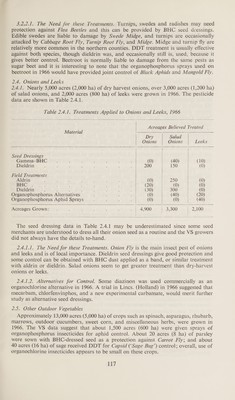
![that the 13,000 acres (5,300 ha) of fruiting cherries in England and Wales were often damaged by Cherry Fruit Moth in the absence of treatment, and that DDT was applied to approximately 10,000 acres (4,000 ha) of cherries for moth control in that year. The single cherry grower who responded in the 1965 survey, used DDT for this purpose. By 1967/68 the cherry acreage had declined to 9,200 (3,700 ha), partly because of virus diseases, and 3,300 acres (1,300 ha) were treated with DDT for fruit moth control. A further 2,600 acres (1,100 ha) were given DDT, mainly for caterpillar control. Table 3.2.1. Treatments Applied to Pears and Plums, 1965 Basic Acreages Material of Mature Fruit Believed Treated Organochlorine Pesticides BEC; .. ‘ ‘ ; ; ‘ 2,100 DDrT,~. : } . ; ae | 13,400 Dicofol . , ‘ : ! : | (800) TDE iis . f . ; OD oO (600) Tetradifon (100) | | Organophosphorus Materials | Azinphos—methyl] ; ; : oi aril 3,100 Demeton—methyl . ; a WS 4,800 Vamidothion . : f ; I 10,200 Other Organophosphorus Sprays : Sits 4,500 Other Relevant Pesticides | Binapacryl . . I ? dent (100) Carbaryl : . : JA ot (100) Lead Arsenate : ; tn 2 (300) Lime Sulphur ; ; ; | (400) Oxythioquinox 4 ; ; : Tehsi| (400) Acreage of Mature Pears and Plums Grown 19626 cre. ; : . F ; si 36,400 3.2.1.1. The Need for Pear Pest Control. The position is similar to that with apples, where a potential capsid problem makes the elimination of pre-blossom DDT difficult at present, though a petal fall spray with an organophosphorus material might be more effective than with apple because pears blossom earlier in the year. One trial in 1966 showed that carbaryl could replace DDT for control of Pear Midge, which is a minor pest in commercial orchards nowadays and seldom needs treatment. 3.2.1.2. The Need for Plum and Cherry Pest Control. Caterpillars, including Cherry Fruit Moth, are normally controlled with DDT and TDE. There is little experimental evidence on alternatives, but by inference from apple trials DDT could probably be replaced by organophosphorus compounds. Azinphos-methyl gave good control of caterpillars in one recent trial on plums. Aphids were controlled by BHC and DDT, but nowadays tend to be treated with organophosphorus sprays. Plum Sawfly was treated with BHC, but dimethoate and demeton-methy] are good alternatives. Plum Fruit Moth also responded to control with DDT. Again, there is a lack of trial evidence on effective alternatives for use in England and Wales, though azinphos- methyl has proved effective in Europe and could probably replace DDT. 3.3. Soft Fruit 3.3.1. Again there is a lack of information on the pesticide programmes followed by commercial growers. Some estimates for 1960-63 were made by Strickland (3965),](https://iiif.wellcomecollection.org/image/b32173076_0126.jp2/full/800%2C/0/default.jpg)




 No text description is available for this image
 No text description is available for this image
 No text description is available for this image