Further review of certain persistent organochlorine pesticides used in Great Britain.
- Great Britain. Advisory Committee on Pesticides and Other Toxic Chemicals
- Date:
- 1969
Licence: Public Domain Mark
Credit: Further review of certain persistent organochlorine pesticides used in Great Britain. Source: Wellcome Collection.
149/156 page 143
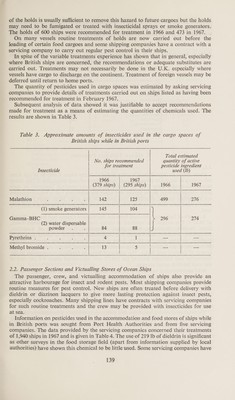
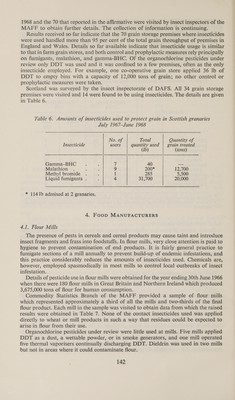
![Table 7. Amounts of insecticides, calculated from raised sample results, used in all mills in the United Kingdom, July 1965—June 1966 Quantity used (Ib) Insecticide ———————_—] “~~ —_ England Northern and Wales Scotland Ireland DDT. : : : 29 — — Dieldrin , i ; <1 <1 ae Gamma-BHC 2 ; 512 3 51 - Organophosphorus insecticides : ; 280 Zh 14 Pyrethrins. * : 46 5 2 Methyl bromide . : 47,603 5,673 2,258 Hydrogen cyanide . , 3,585 — — Liquid fumigants} . , 4,751 205 172 * Includes an estimated 6 lb DDT used as a rodenticide. ¢ Carbon tetrachloride, ethylene dichloride, and ethylene dibromide. 4.2. Chocolate and Sugar Confectionery The chocolate and confectionery industry uses a wide range of unprocessed food including edible nuts, cocoa beans, and dried fruit, which are subject to infestation by pests. In 1967, the year of the survey, the total intake of these three commodities by this industry amounted to 118,000 tons or nearly 14 per cent of all ingredients used. At the time of the survey there were 111 manufacturers of chocolate and sugar confectionery in Great Britain. Information on pesticides used in this industry were obtained with the co-operation of the Cocoa, Chocolate and Confectionery Alliance and the Commodity Statistics Branch of MAFF selected a stratified sample of firms whose combined intake of unprocessed food was two-thirds of the total used by the industry. All firms in the sample were visited to obtain further details of pesticides used. A high proportion of edible nuts, cocoa beans, and dried fruit, are treated with pesticides before arrival at the premises of the manufacturers in this industry. Treatments carried out before, at the time of import, or while in a store awaiting delivery to manufacturers, have been discussed elsewhere (see Section 1). Commodities at the premises of the manufacturers are stored under conditions where serious infestations are unlikely to develop. If treatment is necessary the utmost care is taken to ensure that raw materials and manufactured products do not have their quality impaired by contamination with pesticides. The indications are that the quantity of pesticides used is fairly small in relation to food throughput. Furthermore, there is considerable reliance on physical control measures such as electrified grid devices, wire mesh screens on windows, and double doors, which have contributed to a low incidence of infestation. Of the organochlorine pesticides, only DDT and dieldrin were used, but confined to areas where contamination of food was unlikely. The preferred insecticides were pyrethrins and gamma-BHC for both control and prophylactic treatment. Arprocarb, diazinon, and malathion, were used to some extent and dichlorvos, rotenone, and carbaryl, used very occasionally. Fumigants were employed by few of the manufacturers visited. 4.3. Bacon Factories There were 140 bacon factories slaughtering pigs in Great Britain in 1966, the year in which pesticide usage was recorded, and 5,123,584 pigs were processed. The Commodity Statistics Branch of the MAFF provided a sample of bacon factories which represented approximately 30% of the factories and 35% of the pig throughput.](https://iiif.wellcomecollection.org/image/b32173076_0149.jp2/full/800%2C/0/default.jpg)