Practical sanitation : a handbook for sanitary inspectors and others interested in sanitation / by George Reid ; with an appendix on sanitary law / by Herbert Manley.
- Reid, George, 1854-1925
- Date:
- 1895
Licence: Public Domain Mark
Credit: Practical sanitation : a handbook for sanitary inspectors and others interested in sanitation / by George Reid ; with an appendix on sanitary law / by Herbert Manley. Source: Wellcome Collection.
108/382 (page 94)
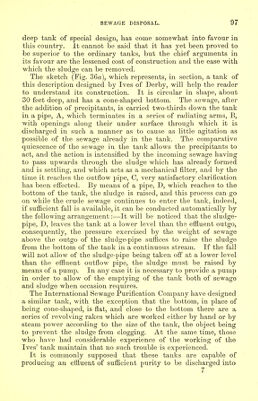
![to look through, and to pass a rod through from one end to the other of the drains and their tributaries, amply repays the extra outlay. A manhole chamber (Fig. 36), is built of brick-work set in cement, and the drain or sewer is continued along the floor of the chamber by means of open half-channel pipes set in a bed of concrete. The surface of the concrete should be raised some inches above the edges of the half-channel pipes to prevent the sewage from overflowing on to the floor of the chamber, and it should be floated with cement all over so as to present a smooth and impervious surface. At points along the main channel tributary drains are connected by means of curved half-channels similarly laid in concrete, the junctions being formed by special half channel junctions being introduced in the course of the main channel at these points. All street manholes should be fitted with a perforated iron lid to allow of the free circulation of air in the sewers (see p. 78), a bucket or tray being suspended under the perforations to catch any dirt that may enter from the road. In the case of private drains, the manhole lids should be air-tight, with the exception of the terminal one which ought to be perforated for the admission of air to pass along the drains and up the ventilators at the top ends of the main drain and its tributaries, a syphon trap being introduced at the outlet from the manhole into the sewer or cesspool as the case may be.* So much for the points that have to be attended to in con- nection with the laying of drains and sewers. A description of the various forms of traps has purposely been omitted at this stage, as they may more fitly be described when sanitary ap- pliances come to be considered. Methods of Sewage Disposal. The methods of sewage disposal have next to be considered, and these, like drainage construction, have to be viewed in the light of the principles laid down in the former Chapter, always remembering that, although the details must necessarily vary with circumstances, none are right which do not comply with established rules. To give anything approaching a detailed account of the various recognised plans of sewage treatment would far exceed the limits of this elementary treatise ; those who wish, therefore, to follow the subject farther will do well to read a recent work on the subject by Mr. Santo Crimp, entitled Sewage Disposal Works. * See footnote, p. 76, and also p. ] 15.](https://iiif.wellcomecollection.org/image/b20407506_0108.jp2/full/800%2C/0/default.jpg)