Volume 1
Handbook of flower pollination : based upon Hermann Müller's work ʻThe fertilisation of flowers by insectsʼ / by Dr. Paul Knuth ; translated by J.R. Ainsworth Davis.
- Paul Knuth
- Date:
- 1906-1909
Licence: Public Domain Mark
Credit: Handbook of flower pollination : based upon Hermann Müller's work ʻThe fertilisation of flowers by insectsʼ / by Dr. Paul Knuth ; translated by J.R. Ainsworth Davis. Source: Wellcome Collection.
411/418 page 385
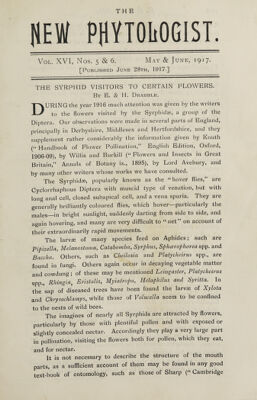
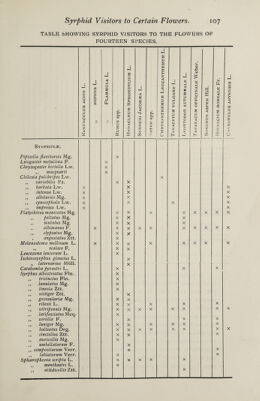
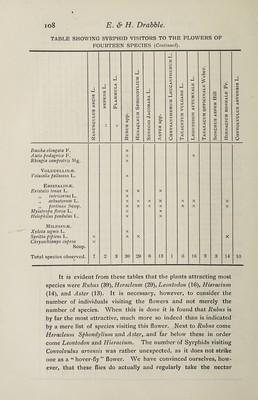
![THE PHVTOliOGIST. Vol. XVI, Nos. 5 & 6. M AY & JUNE, 1917. [Published June 28th, 1917.] THE SYRPHID VISITORS TO CERTAIN FLOWERS. By E. & H. Drabble. DURING the year 1916 much attention was given by the writers to the flowers visited by the Syrphidae, a group of the Diptera. Our observations were made in several parts of England, principally in Derbyshire, Middlesex and Hertfordshire, and they supplement rather considerably the information given by Knuth (“ Handbook of Flower Pollination,” English Edition, Oxford, 1906-09), by Willis and Burkill (“ Flowers and Insects in Great Britain,” Annals of Botany ix., 1895), by Lord Avebury, and by many other writers whose works we have consulted. The Syrphidae, popularly known as the “ hover flies,” are Cyclorrhaphous Diptera with muscid type of venation, but with long anal cell, closed subapical cell, and a vena spuria. They are generally brilliantly coloured flies, which hover—particularly the males_in bright sunlight, suddenly darting from side to side, and again hovering, and many are very difficult to “ net” on account of their extraordinarily rapid movements. The larvae of many species feed on Aphides; such are Pipizella, Melanostoma, Catabomba, Syrphus, Sphcerophorea spp. and Baccha. Others, such as Cheilosia and Platycheivus spp., are found in fungi. Others again occur in decaying vegetable matter and cowdung; of these may be mentioned Leiogaster, Platycheivus spp., Rhingia} Eristalis, Myiatropa, Helophilus and Syritta. In the sap of diseased trees have been found the larvae of Xylota and Chvysochlamys, while those of Volucella seem to be confined to the nests of wild bees. The imagines of nearly all Syrphids are attracted by flowers, particularly by those with plentiful pollen and with exposed or slightly concealed nectar. Accordingly they play a very large part in pollination, visiting the flowers both for pollen, which they eat, and for nectar. It is not necessary to describe the structui e of the mouth parts, as a sufficient account of them may be found in any good text-book of entomology, such as those of Sharp (“ Cambridge](https://iiif.wellcomecollection.org/image/b31348440_0001_0411.jp2/full/800%2C/0/default.jpg)