A text-book of human physiology / by Dr. Robert Tigerstedt ... tr. from the 3d German ed. and edited by John R. Murlin ... with an introduction to the English ed., by Professor Graham Lusk.
- Robert Tigerstedt
- Date:
- 1906
Licence: Public Domain Mark
Credit: A text-book of human physiology / by Dr. Robert Tigerstedt ... tr. from the 3d German ed. and edited by John R. Murlin ... with an introduction to the English ed., by Professor Graham Lusk. Source: Wellcome Collection.
Provider: This material has been provided by the Augustus C. Long Health Sciences Library at Columbia University and Columbia University Libraries/Information Services, through the Medical Heritage Library. The original may be consulted at the the Augustus C. Long Health Sciences Library at Columbia University and Columbia University.
54/794 page 18
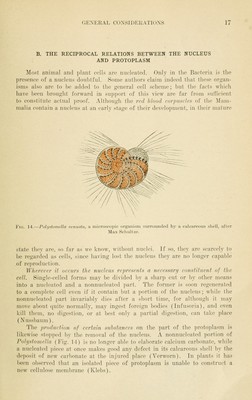
![Bv the influonce of a low tern pent hire on the cell of Sj)irog!/ra caught in the act of division. Gerassimow succeeded in driving all the nuclear substance into one daughter cell, leaving the other quite devoid of a nucleus. In a series of such experiments it was seen that in twenty-one days the growth of the enucleated cells amounted to 0.4-4.5 per cent of the average growth of the normal cell, while the growth of the cells with a surplus of nuclear material exceeded that of the normal cells by as much as seventy-eight per Fig. 15.—A radiolarian, Thalassirola nucleata, after Verworn. Cross section of a normal indi- vidual. The layer.s from without inward are: the corona of radial pseudopodia, the gelat- inous layer, va.scular layer, pigmented sheath about the central capsule, and the central cap- sule (in the center). cent. At the same time the solution of starch in the enucleated cells either did not take place at all or proceeded very feebly; tlie outer cell membrane was less extensible than usual; the color of the chiorophvll bands became constantly ])aler and their contour less clear. While the nucleus is tluis of the greatest importance for the normal activity of tlie protoplasm, it cannot maintain an independent existence. When the protoplasm is paralyzed with narcotics the nucleus may indeed continue its movements (Demoor), showing itself quite as independent of the protoplasm as the protoplasm is of the nucleus. Nevertheless, if removed entirely from the protoi)lasm, even if it be entirely uninjured by the manipulation and be protected from all external disturbances, as has been done in the case of the great radiolarian. Thnlassicola (Fig. 15, Verworn), the nucleus invariably perishes without exhibiting any trace of regeneration. Xor do nuclei ever](https://iiif.wellcomecollection.org/image/b21205747_0054.jp2/full/800%2C/0/default.jpg)



 No text description is available for this image
 No text description is available for this image
 No text description is available for this image