A text-book of human physiology / by Dr. Robert Tigerstedt ... tr. from the 3d German ed. and edited by John R. Murlin ... with an introduction to the English ed., by Professor Graham Lusk.
- Robert Tigerstedt
- Date:
- 1906
Licence: Public Domain Mark
Credit: A text-book of human physiology / by Dr. Robert Tigerstedt ... tr. from the 3d German ed. and edited by John R. Murlin ... with an introduction to the English ed., by Professor Graham Lusk. Source: Wellcome Collection.
Provider: This material has been provided by the Augustus C. Long Health Sciences Library at Columbia University and Columbia University Libraries/Information Services, through the Medical Heritage Library. The original may be consulted at the the Augustus C. Long Health Sciences Library at Columbia University and Columbia University.
78/794 page 42
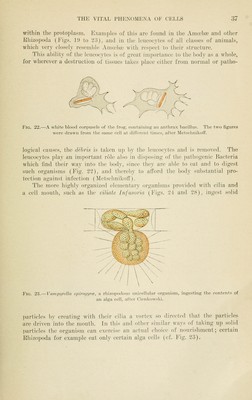
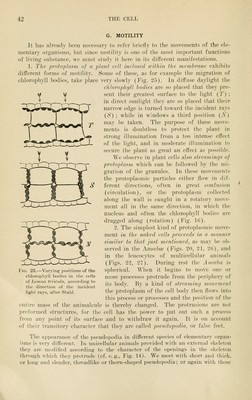
![G. MOTILITY It has alreadv Ijcen necessary to refer briefly to the movements of the ele- mentary organisms, but since motility is one of the most important functions of living substance, we must study it here in its different manifestations. 1. llie protoplasm of a plant cell inclosed within the membrane exhibits diiferent forms of motility. Some of these, as for example tlie migration of chlorophyll bodies, take place very slowly (Fig. 25). In diffuse daylight the chlorophyll bodies are so placed that they pre- sent their greatest surface to the light (T) \ in direct sunlight they are so placed that their narrow edge is turned toward the incident rays (S) ; while in windows a third position (N) may be taken. The purpose of these move- ments is doubtless to protect the plant in strong illumination from a too intense effect of the light, and in moderate illumination to secure the plant as great an effect as possible. We observe in plant cells also streamings of protoplasm which can be followed by the mi- gration of the granules. In these movements the protoplasmic particles either flow in dif- ferent directions, often in great confusion (circulation), or the protoplasm collected along the wall is caught in a rotatory move- ment all in the same direction, in which the nucleus and often the chlorophyll bodies are dragged along (rotation) (Fig. 16). 2. The simplest kind of protoplasmic move- ment in the naked cells proceeds in a manner similar to that just mentioned, as may be ol)- served in the xlmrebte (Figs. 30, 21, 26), and in the leucocytes of multicellular animals (Figs. 22, 27). During rest the Am.o'ba is spherical. When it begins to move one or more processes protrude from the periphery of its body. By a kind of streaming movement the protoplasm of the cell body then flows into this process or processes and the position of the entire mass of the animalcule is there])y changed. The protrusions are not preformed structures, for the cell has the power to put out such a process from any point of its surface and to withdraw it again. It is on account of their transitory character that they are called pseudopodia. or false feet. The appearance of the pseudo])odia in different species of elementary organ- isms is very different. In unicellidar animals provided with an external skeleton they arc modified according to the character of the openings in the skeleton through which they protrude (cf. e.g., Fig. 14). We meet with short and thick, or long and slender, threadlike or thorn-shaped pseudopodia; or again with those Fig. 25.—Varying positions of the chlorophyll bodies in the cells of Lemna triscula, according to the direction of the incident light rays, after Stalil.](https://iiif.wellcomecollection.org/image/b21205747_0078.jp2/full/800%2C/0/default.jpg)


 No text description is available for this image
 No text description is available for this image
 No text description is available for this image