A text-book of human physiology / by Dr. Robert Tigerstedt ... tr. from the 3d German ed. and edited by John R. Murlin ... with an introduction to the English ed., by Professor Graham Lusk.
- Robert Tigerstedt
- Date:
- 1906
Licence: Public Domain Mark
Credit: A text-book of human physiology / by Dr. Robert Tigerstedt ... tr. from the 3d German ed. and edited by John R. Murlin ... with an introduction to the English ed., by Professor Graham Lusk. Source: Wellcome Collection.
Provider: This material has been provided by the Augustus C. Long Health Sciences Library at Columbia University and Columbia University Libraries/Information Services, through the Medical Heritage Library. The original may be consulted at the the Augustus C. Long Health Sciences Library at Columbia University and Columbia University.
95/794 page 59
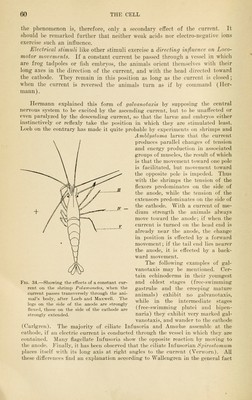
![on the excitability, and the phenomena just mentioned are regarded by some as the expression of actual stimulation. As an example of the directive ^ influence of heat on the movements of cells {thermotaxu) the behavior of the ciliate Infusorian, Paramcecium. may be mentioned. If the vessel in which they are contained is warmed on one side to about 34°-28° C. the animalcules withdraw to the other side, while with a temperature below this limit they wander to the warmer side—opposite movements therefore according as the same stimulus is strong or weak. G. ELECTRICAL STIMULATION Because they are the most easily manipulated and most easily graduated, electrical stimuli have been studied with very great exactness. Since their effects are investigated chiefly on nerves and muscles of the vertebrates, we shall deal with them at some length in presenting the physiology of nerves and muscles. Suffice it for the present to state that it has been found in nerves and muscles that the electrical current stimulates only at one pole or the other, at the negative pole on closing the current, and at the positive on hreaking it (Pfliiger). Between the two poles it acts to change the excita- bility, but not to stimulate. In Paramcecium, excitation is said to take place with the closing of the current at the anode (Verworn). And there are other exceptions to the law as it applies to nerve and muscle. Carlgren has shown with regard to Paramce- cium, that lifeless individuals, immediately after the closing of a sufficiently strong constant current, show at the anode a shrinking up and at the cathode bending movements, both of which are the consequence of the so-called cata- phoric effect of the constant current [i. e., the tendency which this current has to sweep substances in solution along with it—Ed.] ; and it is not at all improb- able that similar phenomena in the living' Paramcecium are of the same origin. The following phenomenon might be presented as a secondary effect of the electric current. If a salamander {Amhh/stoma) be traversed longitu- dinally by an electric current, the skin glands of the animal begin to produce a copious secretion, which appears only on the side of the anode. The same occurs also with isolated pieces of the animal in which the spinal cord has been destroyed. But this secretion, as Loeb has shown, is not excited by the current itself, but by the electro-positive ions liberated by the current. For if the animal is immersed in a NaCl solution, the electro-positive ions in their migration toward the cathode are set free on the skin of the animal and are combined with the hydroxyl of water into XaOH. As direct experiments have proved, this alkali exercises a powerful stimulating effect on the skin glands; 1 Jennings is of the opinion that these so-called directive influences of light and of heat are merel}^ other instances of the selection by random movements of conditions favor- able to the life processes. Taking Paramcecium as an example we find that when it wanders into a degree of illumination or of temperature which is unfavorable, the organism is stim- ulated by the change and reacts by making the usual motor response for avoiding an ob- stacle. The total eflfect of many such responses is to carrj' the organism out of the field of unfavorable influences or to keep it in the field of favorable ones.—Ed. 6](https://iiif.wellcomecollection.org/image/b21205747_0095.jp2/full/800%2C/0/default.jpg)



 No text description is available for this image
 No text description is available for this image
 No text description is available for this image