Volume 1
A text-book of human physiology : including histology and microscopical anatomy with special reference to the requirements of practical medicine / by L. Landois ; translated from the seventh German edition with additions by William Stirling.
- Landois, L. (Leonard), 1837-1902. Lehrbuch der Physiologie des Menschen. English
- Date:
- 1891
Licence: Public Domain Mark
Credit: A text-book of human physiology : including histology and microscopical anatomy with special reference to the requirements of practical medicine / by L. Landois ; translated from the seventh German edition with additions by William Stirling. Source: Wellcome Collection.
31/602 page 27
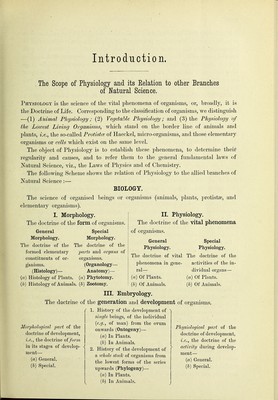
![Introduction. The Scope of Physiology and its Relation to other Branches of Natural Science. Physiology is the science of the vital phenomena of organisms, or, broadly, it is the Doctrine of Life. Corresponding to the classification of organisms, we distinguish —(1) Animal Phijsiology; (2) Vegetable Physiology; and (3) the Physiology of the Lowest Living Organisms, which stand on the border line of animals and plants, i.e., the so-called Protistce of Haeckel, micro-organisms, and those elementary organisms or cells which exist on the same level. The object of Physiology is to establish these phenomena, to determine their regularity and causes, and to refer them to the general fundamental laws of K'atural Science, viz., the Laws of Physics and of Chemistry. The following Scheme shows the relation of Physiology to the allied branches of ]!^atural Science :— BIOLOGY. The science of organised beings or organisms (animals, plants, protistse, and elementary organisms). II. Physiology. The doctrine of the vital phenomena I. Morphology. The doctrine of the form of organisms. General Special Morphology. Morphology. Tlie doctrine of tlie The doctrine of tlie formed elementary jjarts and organs of constituents of or- organisms. ganisms. (Organology— (Histology)— Anatomy)— (a) Histology of Plants, {a) Phytotomy. (6) Histology of Animals, {b) Zootomy. III. Embryology. The doctrine of the generation and development of organisms. of organisms. General Physiology. The doctrine of vital phenomena in gene- ral— (a) Of Plants. {h) Of Animals. Special Physiology. The doctrine of the activities of the in- dividual organs— {a) Of Plants. {b) Of Animals. Morpliological imrt of the doctrine of development, i.e., the doctrine of form in its stages of develop- ment— {a) General. (6) Special. ( 1. History of the development of ^ I single beings, of the individual {e.g., of man) from the ovum onwards (Ontogeny)— {a) In Plants. 1 (6) In Animals. 2. History of the development of a whole stock of organisms from the lowest forms of the series upwards (Phylogeny)— (a) In Plants. (])) In Animals. Physiological part of the doctrine of development, i.e., the doctrine of the )- activity during develop- ment— {a) General. {b) Special.](https://iiif.wellcomecollection.org/image/b20417688_001_0031.jp2/full/800%2C/0/default.jpg)


 No text description is available for this image
 No text description is available for this image
 No text description is available for this image