Volume 1
A text-book of human physiology : including histology and microscopical anatomy with special reference to the requirements of practical medicine / by L. Landois ; translated from the seventh German edition with additions by William Stirling.
- Landois, L. (Leonard), 1837-1902. Lehrbuch der Physiologie des Menschen. English
- Date:
- 1891
Licence: Public Domain Mark
Credit: A text-book of human physiology : including histology and microscopical anatomy with special reference to the requirements of practical medicine / by L. Landois ; translated from the seventh German edition with additions by William Stirling. Source: Wellcome Collection.
47/602 (page 7)
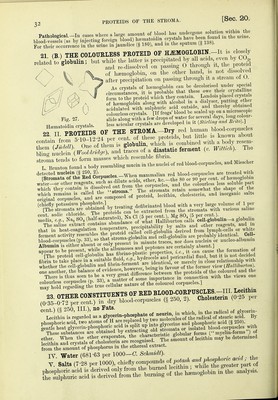
![that the surfaces of the corpuscles were so altered that they became adhesive. Norris made ex- periments with corks weighted with tacks or pins, so as to produce partial submersion of the cork discs. These discs rapidly cohere, owing to capillarity, and form rouleaux. If the discs be completely submerged they remain apart, as occurs with unaltered blood-corpuscles within the blood-vessels. If, however, the corpuscles be dipped in petroleum, and then placed in water, rouleaux are formed.] If reagents which cause the corpuscles to swell up be added to the blood, the corpuscles become globular and the rouleaux break up. According to E. Weber and Suchard, the uniting medium is not fibi'in (although it may sometimes assume a fibrous form), but belongs to the peripheral layer of the corpuscles. (c) Changes of Form.—The discharge of a Leyden jar causes the corpuscles to Fig. 7. Red blood-corpuscles. «, h, normal human red corpuscles, the central depression more or less in focus ; c, cl, e, mulberry, and g, h, crenated forms ; k, pale corpuscles decolorised by water ; I, stroma ; /, frog's blood-corpuscle acted on by a strong saline solution. crenate, so that their surfaces are beset with coarse or fine projections (fig. 7, c, d, e, g, h); it also causes the corpuscles to assume a spherical form (i, i), and they become smaller than normal. The corpuscles so altered are sticky, and run together like ^^-^ Q drops of oil, forming larger spheres. The pro- ^^' ^^P^'' (5°o longed action of the electrical spark causes the ^ haemoglobin to separate from the stroma (k), %^ ^ ^^^^^^^ Q whereby the fluid part of the blood is reddened, ° V while the stroma is recognisable only as a faint ^--ilj o?-r) shadow (I). Similar forms are to be found in ''^ r?orx ^ decomposing blood, as well as after the action of O many other reagents. Heat.—When blood is o ° heated, on a warm stage, to 52° C. the corpuscles <^ o't-^ exhibit remarkable changes. Some of them become spherical, others biscuit-shaped; some are per- Fig. 8. forated, while in others small portions become Effect of heat on human coloured detached and swim about in the surrounding fluid, blood-corpuscles. {Stirling) a proof that heat destroys the histological indi- x 400. viduality of the corpuscles (fig. 8). If the heat be continued, the corpuscles are dissolved (§ 10, 3). The addition of a concentrated solution of urea to blood acts like heat on the blood-cor- puscles. If strong pressure be exerted upon a microscopic preparation, the blood-corpuscles may break in pieces. The latter ]irocess is called hsemocytotrypsis, in contradi^inction to that of solution of the corpuscles or haemocytolysis. If a finger moistened with blood be rapidly drawn across a Avarm slip of glass, so that the fluid dries rapidly, the corpuscles exhibit very remarkable shapes, showing their great ductility and softness. [Water renders the red corpuscles spherical, although some of them do not become quite so, as there remains a slight depression or umbilicus on one side of the corpuscle. Gradually they are decolorised, and only the stroma—the outline of which is difficult to see—remains in the field of the microscope (fig. 7, Tc, I), The water passes into the corpuscles by osmosis, and dissolves out the heemoglobin.l](https://iiif.wellcomecollection.org/image/b20417688_001_0047.jp2/full/800%2C/0/default.jpg)