Volume 1
A text-book of human physiology : including histology and microscopical anatomy with special reference to the requirements of practical medicine / by L. Landois ; translated from the seventh German edition with additions by William Stirling.
- Landois, L. (Leonard), 1837-1902. Lehrbuch der Physiologie des Menschen. English
- Date:
- 1891
Licence: Public Domain Mark
Credit: A text-book of human physiology : including histology and microscopical anatomy with special reference to the requirements of practical medicine / by L. Landois ; translated from the seventh German edition with additions by William Stirling. Source: Wellcome Collection.
540/602 page 500
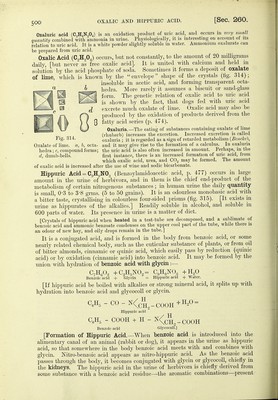
![OXALIC AND HIPPURIC ACID. [SeC. 260. Oxaluric acid (C3H4N„04) is an oxidation product of uric acid, and occurs m very small Quantity combined with ammonia in nrine. Physiologically, it is interesting on acconiit of its relation to uric acid. It is a white powder slightly soluble in water. Ammonium oxalurate can be prepared from uric acid. Oxalic Acid (GgH^O^) occurs, but not constantly, to the amount of 20 miUigrams daily, [but never as free oxaHc acid]. It is united with calcium and held in solution by the acid phosphate of soda. Sometimes it forms a deposit of oxalate of lime, which is known by the envelope shape of the crystals (fig. 314); insoluble in acetic acid, and forming transparent octa- hedra. More rarely it assimies a biscuit or sand-glass form. The genetic relation of oxalic acid to inic acid is shown by the fact, that dogs fed with uric acid excrete much oxalate of lime. Oxalic acid may also be produced by the oxidation of products derived from the fatty acid series (p. 474). Oxaluria.—The eating of substances containing oxalate of lime (rhubarb) increases the excretion. Increased excretion is called Fig- 314. oxaluria ; it is regarded as a sign of retarded metabolism {BeneJce), Oxalate of lime, a, h, octa- and it may give rise to the formation of a calculus. In oxaluria hedra; c, compound forms; the uric acid is also often increased in amount. Perhaps, in the d, dumb-bells. first instance, there is an increased formation of uric acid, from which oxalic acid, urea, and CO2 may be formed. The amount of oxalic acid is increased after the use of wine and sodic bicarbonate. Hippuric Acid = C^IIgNOg (Benzoylamidoacetic acid, p. 477) occurs in large amount in the urine of herbivora, and in them is the chief end-product of the metabolism of certain nitrogenous substances; in hiunan urine the daily quantity- is small, 0-3 to 3-8 grms. (5 to 50 grains). It is an odourless monobasic acid with a bitter taste, crystaUising in colourless four-sided prisms (fig. 315). [It exists in urine as hippurates of the alkalies.] Keadily soluble in alcohol, and soluble in 600 parts of water. Its presence in urine is a matter of diet. [Crystals of hippuric acid when heated in a test-tube are decomposed, and a sublimate of benzoic acid and ammonic benzoate condenses on the upper cool part of the tube, while there is an odour of new hay, and oily drops remain in the tube.] It is a conjugated acid, and is formed in the body from benzoic acid, or some nearly related chemical body, such as the cuticular substance of plants, or froni oil of bitter almonds, cinnamic or quinic acid, which easily pass by reduction (quinic acid) or by oxidation (cinnamic acid) into benzoic acid. It may be formed by the union with hydration of benzoic acid with glycin:— C.HgO^ +C2H5N02= C.H^KOg -l-H^O Benzoic acid -\- Glycin = Hiijpuric acid -|- Water. [If hippuric acid be boiled with alkahes or strong mineral acid, it splits up with hydration into benzoic acid and glycocoll or glycin, Hippuric acid C„H, - GOCH 4. H - N<c^^ _ cooH Benzoic acid Glycocoll.] [Formation of Hippuric Acid.—When benzoic acid is introduced into the ahmentary canal of an animal (rabbit or dog), it appears in the urine as hippuric acid, so that somewhere in the body benzoic acid meets with and combines with glycin. Nitro-benzoic acid appears as nitro-hippuric acid. As the benzoic acid passes through the body, it becomes conjugated with glycin or glycocoll, chiefly in the kidneys. The hippuric acid in the urine of herbivora is chiefly derived from some substance with a benzoic acid residue—the aromatic combinations—present](https://iiif.wellcomecollection.org/image/b20417688_001_0540.jp2/full/800%2C/0/default.jpg)


 No text description is available for this image
 No text description is available for this image
 No text description is available for this image