Volume 1
A text-book of human physiology : including histology and microscopical anatomy with special reference to the requirements of practical medicine / by L. Landois ; translated from the seventh German edition with additions by William Stirling.
- Landois, L. (Leonard), 1837-1902. Lehrbuch der Physiologie des Menschen. English
- Date:
- 1891
Licence: Public Domain Mark
Credit: A text-book of human physiology : including histology and microscopical anatomy with special reference to the requirements of practical medicine / by L. Landois ; translated from the seventh German edition with additions by William Stirling. Source: Wellcome Collection.
585/602 page 545
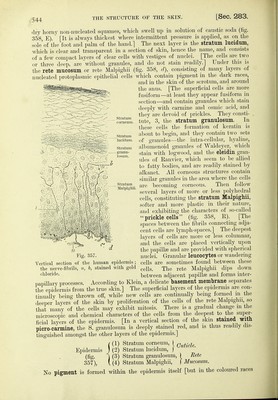
![pigment-granules of melanin exist in the cells of the deepest layers of the stratum Malpighii]; when it is present, it is carried by leucocytes from the subcutaneous tissue {Rield, Ehrmann, Aehij). This explains how it is that a piece of white skin, trans]-)lanted to a negro, becomes black {Kanj). Fig. 358. I, Vertical section of the skin, with a hair and sebaceous gland, T. Epidermis and chorium shortened—1, outer ; 2, inner fibrous layer of the hair-folHcle ; 3, its hyahne layer ; 4, outer root-sheath ; 5, Huxley's layer of the inner root-sheath ; 6, Henle's layer of the same ; p, root of the hair, with its papilla ; A, arrector pili muscle ; C, chormm ; a, sub- cutaneous fatty tissue ; h, epidermis (horny layer) ; d, rete Malpighii ; cj, blood-vessels ot papillfe ; v, lymphatics of the same ; h, horny or corneous substance ; i, medulla or pith ; k, epidermis or cuticle of hair ; K, coil of sweat-gland ; E, epidermal scales (seen from above and en face) from the stratum corneum ; R, prickle cells from the rete Malpighn ; n, super- ficial, and m, deep cells from the nail; H, hair magnified; c, cuticle ; c, medulla, with cells; . /, /, fusiform fibrous cells of the substance of the hair ; x, cells of Huxley's layer ; 1, those of Henle's layer ; S, transverse section of a sweat-gland from the axilla ; a, smooth mus- cular fibres surrounding it; t, cells from a sebaceous gland, some of them containing granules of oil. [Herxheimer has described some peculiar spirals in the epidermis. They seem to be due to coagulation of a proteid.] The chorium (fig. 358, I, C) is beset over its entire surface by numerous (0'5 35](https://iiif.wellcomecollection.org/image/b20417688_001_0585.jp2/full/800%2C/0/default.jpg)



 No text description is available for this image
 No text description is available for this image
 No text description is available for this image