Volume 1
A text-book of human physiology : including histology and microscopical anatomy with special reference to the requirements of practical medicine / by L. Landois ; translated from the seventh German edition with additions by William Stirling.
- Landois, L. (Leonard), 1837-1902. Lehrbuch der Physiologie des Menschen. English
- Date:
- 1891
Licence: Public Domain Mark
Credit: A text-book of human physiology : including histology and microscopical anatomy with special reference to the requirements of practical medicine / by L. Landois ; translated from the seventh German edition with additions by William Stirling. Source: Wellcome Collection.
71/602 page 31
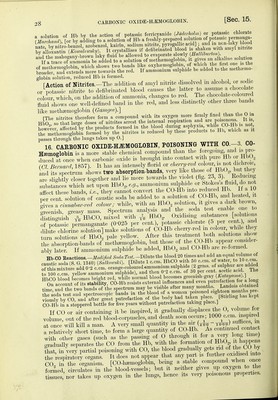
![yellow, appearing raised on the dark field, with a strong absorption of the light parallel to the long axis of the crystals {Falk and Mor ache). They are pleo- chromatic : by transmitted light they are mahogany-brown, and by reflected light bluish-black, glancing like steel. (1) Preparation from Dry Blood-Stains.—Place a few particles of the blood-stain on a glass slide, add 2 to 3 drops of glacial acetic acid and a small crystal of common salt ; cover with a cover-glass, and heat gently over the flame _ of a spirit-lamp until bubbles of gas are ^ ^^ ^ 0^ |A given 00. On cooling, the crystals appear Aa^ ^ [l j' '^'^ in the preparation (fig. 26). i#P^V a ^ (2) From Stains on Porous Bodies.— (/\^ ' ^ ,5 The stained object (cloth, wood, blotting- ^ paper, earth) is extracted with a small 4 quantity of dilute caustic potash, and /r~7 4 ^ afterwards with water in a watch-glass, >^ ^ Both solutions are carefully filtered, and ALM S tannic acid and glacial acetic acid are ^^^^r , ^ X added until an acid reaction is obtained. ^^^^^^^ 4v ^'^ ^ The dark precipitate which is formed is ^ ' jg. vk 6 i \ h collected on a filter and washed. A small ^ ^^^V part of it is placed on a microscope slide, a granule of common salt is added, and . the whole dried; the dry stain is treated Hsemm crystals. 1, human ; 2, seal; 3, calf; as in (1) {Stniwe). 4, pig ; 5, lamb ; 6, pike ; 7, rabbit. (3) From Flnid Blood.-Dry the blood slowly at a low temperature, and proceed as in (1) (4) From Dilute Solutions of Haemoglobin.-(a) Struwe's Method.-Ad.^ to the fluid ammonia tannic acid, and afterwards glacial acetic acid, until it is acid ; a black precipitate of wJ^ff f i^Pi^^' ^J^l^is is isolated, washed, dried, and treated as in (1), but instead of JNaCl a granule of ammonium chloride is added. H^niin crystals may sometimes be prepared from putrefying or lake-coloured blood, but they are very small, and the test often fails. When mixed with iron- rust, as on iron weapons, the blood-crystals are generally not formed In such cases, scrape ofi the stains and boil them with dilute caustic potash If blood be present, the dissolved hsematin forms a fluid, which in a thin layer is green in a thick layer red {H. Rose). ^ ' Hsemin crystals have been prepared from all classes of vertebrates and from the blood of the ''rw-ri r^%^^' ^^Z^ they may be almost amorphous. Chemical Characters.-They are insoluble in water, alcohol, ether, chloroform - but con- centrated H,SO, dissolves them, expelling the HCl, and giving L violet-red colour Ammonk also dissolves them and if the resulting solution be evaporated, heated to 130° C. and^i^ated with boiling water (which extracts the ammonium chloride), h^matoporphyrin- deXS with ^^nlrifi l^^^atom and with Preyer's h^matoin,''is obtained (^o^^.-^t?) It is^ a S^ • '''^r'?f'r^''^°^'>f^^ pounded forms a brown and amorphous powder Its solutions m caustic alkalies are dichroic : in reflected light brownish-red ; in transmitted lisht brown ' '^^ olive-green. T#e acid solutions are monochr^Sicfnd Preparation in Bulk.-To obtain it in quantity, heat dried horse's blood with 10 parts of formic acid. If the crystals be suspended in methyl alcohol, on adding iodine and heatinJ themthey dissolve with a purple colour; after adding bromine, brown; and after pass n^ chlorine gas, green ; all these give a characteristic spectrum Uo:enfeld). ' ^ ^ \Jt. ^^eti^^cid may be replaced by oxalic or tartaric acid, the common salt by salts of lodme or bromine ; m the latter case similar bromine- or iodine-h^^matin is formed {Bikflui) 20. H^MATOIDIN.—Yirchow discovered this important derivative in hsemoglobm. It occurs in the body wherever blood stagnates outside the circula- tion and becomes decomposed-as when blood is extravasated into the tissues— 6 ^. the brain-m solidified blood-plugs or thrombi, especiaUy in veins ; invariably m the Graafian folhcles. It contains no iron (CooH^.N-.O,), and crystaUises in c mo-rhombic prisms (fig. 27) of a yellowish-broU^cofoui \ is soluble in warm SflJirf'' rw^ T:. ^^ P'^^^^^^ i« ^^^^^^'^«^ ^ith the bile-pigment- tbp 1 L^l^e^^acted upon by impure nitric acid (Gmelin's reaction), it gives the same play of colours as bile.] ö](https://iiif.wellcomecollection.org/image/b20417688_001_0071.jp2/full/800%2C/0/default.jpg)



 No text description is available for this image
 No text description is available for this image
 No text description is available for this image