Volume 1
A text-book of human physiology : including histology and microscopical anatomy with special reference to the requirements of practical medicine / by L. Landois ; translated from the seventh German edition with additions by William Stirling.
- Landois, L. (Leonard), 1837-1902. Lehrbuch der Physiologie des Menschen. English
- Date:
- 1891
Licence: Public Domain Mark
Credit: A text-book of human physiology : including histology and microscopical anatomy with special reference to the requirements of practical medicine / by L. Landois ; translated from the seventh German edition with additions by William Stirling. Source: Wellcome Collection.
77/602 page 37
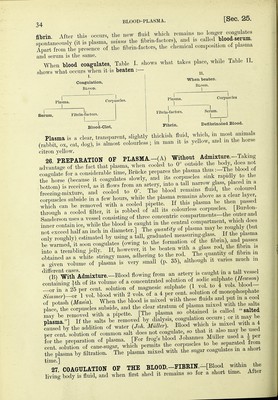
![37 when shed does not coagulate. Schmidt-Mülheim found that after the injection of pcptonr into the blood (0-5 gram per kilo.) of a dog, the blood lost its power of coagulating. [This occurs in the dog, but not in the rabbit. Peptonised blood coagulates when it is treated with CO., or water. It appears, however, that it is not the peptone which prevents the coagulation, but the albiimoses ailhermg to it which do so.] A substance is formed in the plasma, which prevents coagulation but which IS T)recipitated by CO,,. Lymph behaves similarlv {Fano). After peptones are injected, there is a great solution of leucocytes in the blood {v.^Samson-Hiimnelstjerna). The secretion of the mouth of the medicinal leech, [although its action is not due to a ferment {Haycraft)\ and snake poison also prevent coagulation ( Wall). [Diastatic ferment {Salvioli) and tlie poisonous substance in the serum of eels' blood {Mosso) also prevent coagulation.] Haemophilia.—A very slight scratch in some persons may cause very free bleeding. These persons are called colloquially bleeders, and are said to have haemophilia or the hgemorrhagic diathesis. In bleeders coagulation seems not to take place, owing to a want of the substances producing fibrin ; hence, in these cases, wounds of vessels are not plngged with fibrin. [A tendency to haemorrhage occurs in scurvy, purpura, in some infectious^diseases, such as typhus, plague, yellow fever, and in poisoning with phosphorus.] _ [Leech Extract.—A watery extract of the buccal cavity of the leech—the secretion probably is derived from the epithelial cells lining the sucker and buccal cavity—when injected into the blood-vessels of a dog or rabbit, or mixed with the uncoagulated blood of these animals, prevents coagulation for a much longer time than is the case with the injection of so-called peptones for It IS really the albumoses mixed with the peptones which prevent coagulation in the blood of the dog. The action of leech-extract, like that of the products of digestion, is not permanent When injected it produces far milder constitutional symptoms than albumose, but its action on the blood is far more powerful. It is eliminated by the kidneys. So far this active principle has not been isolated, although it is soluble in water, saline solutions, and insoluble m alcohol, ether, and chloroform {Raijcraft).] III. Coagulation is accelerated—(«) By contact with foreign Substances of all kinds, but only when the blood adheres to them, hence threads or needles introduced into arteries are rapidly covered with fibrin. [The coagulation always begins around the foreign body.] Blood does not coagulate in contact with bodies covered with fat or vasehne {Freund). Even the introduction of air-bubbles into the circulation or the passage of indifferent gases, or H, through blood, accelerates it. The pathologically altered wall of a vessel acts hke a foreign body! Blood shed from an artery .rapidly coagulates on the walls of vessels, on the surfaces exposed freely to air, and on the rods or twigs used to beat it. {h) The products of the retrogressive metabolism of proteids (uric acid, giycin, leucni, taurin, kreatin, sarkin, but not urea) favour coagulation by inc'reasecl ferment-formation ; but if they are added in excess, they retard the process. (c) From a vvatery extract of the testis or thymus, on the addition of acetic acid, is precipitated a substance which is soluble in sodic carbonate. It is a mixture of lecithin and albumin, and when It IS injected into the blood-stream it causes almost instantaneous death by intravascular coagulation {JVooldridge). [Injection of a watery extract of the thymus, supra-renal capsules, and testis suffice to produce extensive intra-vascular clotting, and even the injection of laky blood accelerates coagulation.] ^ ^ (d) During rapid haemorrhage, the last portions of blood coagulate most rapidly {Jiolzmann). (e) Heating the blood from 39° to 55° C. (Hewson). if) Agitation of the blood {Hewson and Hunter), [ig) The addition of a small quantity of water. {h) A loatery condition of the blood. The clot is small and soft. {i) Contact with oxygen, or free exposure to the air. But contact with oxygen is not necessary for coagulation to take place, as this occurs m contact with indifferent gases, as well as in a vacuum.] IV. Rapidity of Coagulation.—Amongst vertebrates, the blood of birds (especially of the pigeon) coagulates almost momentarily; in cold-blooded animals coagulation occurs much more slowly, while mammals stand midway between the miS^'^df f fowl begins to coagulate in 4 to 1^ minute; pig, sheep, rabbit, in i to](https://iiif.wellcomecollection.org/image/b20417688_001_0077.jp2/full/800%2C/0/default.jpg)




 No text description is available for this image
 No text description is available for this image
 No text description is available for this image