A manual of elementary chemistry : theoretical and practical / by George Fownes.
- George Fownes
- Date:
- 1859
Licence: Public Domain Mark
Credit: A manual of elementary chemistry : theoretical and practical / by George Fownes. Source: Wellcome Collection.
551/602 page 563
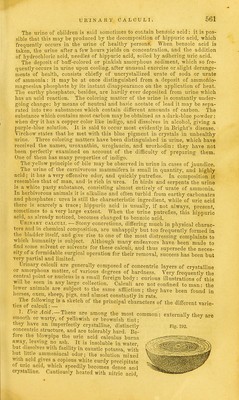
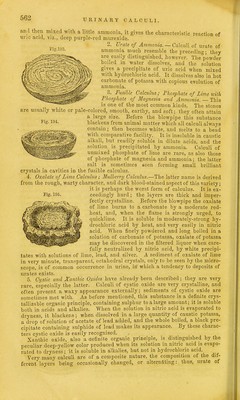
![SWEAT.1—BILE. ammonia and oxalate of lime are not unfrequently associated in the same stone Sweat.—The watery fluid poured out by the skin contains from J to 2 per cent of solid matter: the acidity of the secretion depends on organic acids, chiefly formic; acetic and butyric acids also exist in it. Lactic acid has been stated to be absent even in rheumatism: a new acid named sudoric acid, and somewhat resembling in composition uric acid, is said to be always present, C10H8NO13. In disease, if not in health, small quantities of urea also exist in sweat. The salts in the sweat are chlorides of sodium and potassium. Phos- phoric acid, lime,*magnesia], and oxide of iron have been found. Saliva is a mixture of several fluids secreted by different glands of the mouth. Its specific gravity is from 1002 to 1009. It is usually alkaline: during and after eating the alkaline reaction increases, whilst it decreases by fasting. It contains an albuminous substance, ptyalin, which acts on starch, rapidly changing it into sugar. The secretion of the submaxillary gland with the mucus of the mouth chiefly produces this effect. On the passage of the food into the acid gastric juice, this conversion of starch into sugar ceases. The second remarkable substance in saliva is sulphocyanide of potassium, which exists in very small quantities, but is very easily detected. The solid constituents of saliva are about 1 per cent., and in 100 parts of solid consti- tuents from 7 to 21 parts are fixed salts, chiefly chlorides. Gastric juice contains from 1 to 2 per cent, of solid constituents. It con- tains an albuminous substance, pepsin, by some called chymosin or better gas- teruse. With the acids and water of the gastric juice the albuminous food is much more quickly dissolved than by water and acids alone. The free acids of the stomach are the hydrochloric, lactic, butyric, and acetic; and very probably sulphuric and phosphoric acids in very minute quantities are also free. The saline substances that are present are chlorides of sodium, cal- cium, magnesium, and traces of protochloride of iron and phosphate of lime, but these substances are present in very small quantities. From experiments lately made on a woman who had a fistulous opening in the stomach, it is said that as much as 31 pounds of fluid may sometimes be secreted by the stomach daily. Bile.—This is a secretion of a very different character from the preceding: the largest internal organ of the body, the liver, is devoted to its preparation, which takes place from venous, instead of arterial blood. The composition of the bile has been made the subject of much investigation ; the following is a summary of the most important facts which have been brought to light. In its ordinary state bile is a.very deep-yellow, or greenish, viscid, trans- parent liquid, which darkens by exposure to the air, and undergoes changes which have been yet imperfectly studied. It has a disagreeable odor, a most nauseous, bitter taste, a distinctly-alkaline reaction, and is miscible with water in all proportions. When evaporated to dryness at 212° (100°C) and treated with alcohol, the greater part dissolves, leaving behind an insoluble jelly of mucus of the gall-bladder. This alcoholic solution contains coloring- matter and cholestcrin; from the former it may be freed by digestion with animal charcoal and from the latter by a large admixture of ether, in which the bile is insoluble, and separates as a thick, syrupy, and nearly colorless liquid. Ihe coloring-matter may also be precipitated by baryta-water. Pure bile thus obtained, when evaporated to dryness by a gentle heat, forms a slightly-yellowish brittle mass, resembling gum-arabic. It is completely soluble in water and absolute alcohol. The solution is not affected by the vegetable acids; hydrochloric and sulphuric acids, on the contrary, give rise to turbidity, e. her immediately or after a short interval. Acetate of lead partially prec.pita es it: the tribasic acetate precipitates it completely the precipitate is readily soluble in acetic acid, in alcohol, and to ac?rtain exten?](https://iiif.wellcomecollection.org/image/b21495968_0553.jp2/full/800%2C/0/default.jpg)




 No text description is available for this image
 No text description is available for this image
 No text description is available for this image