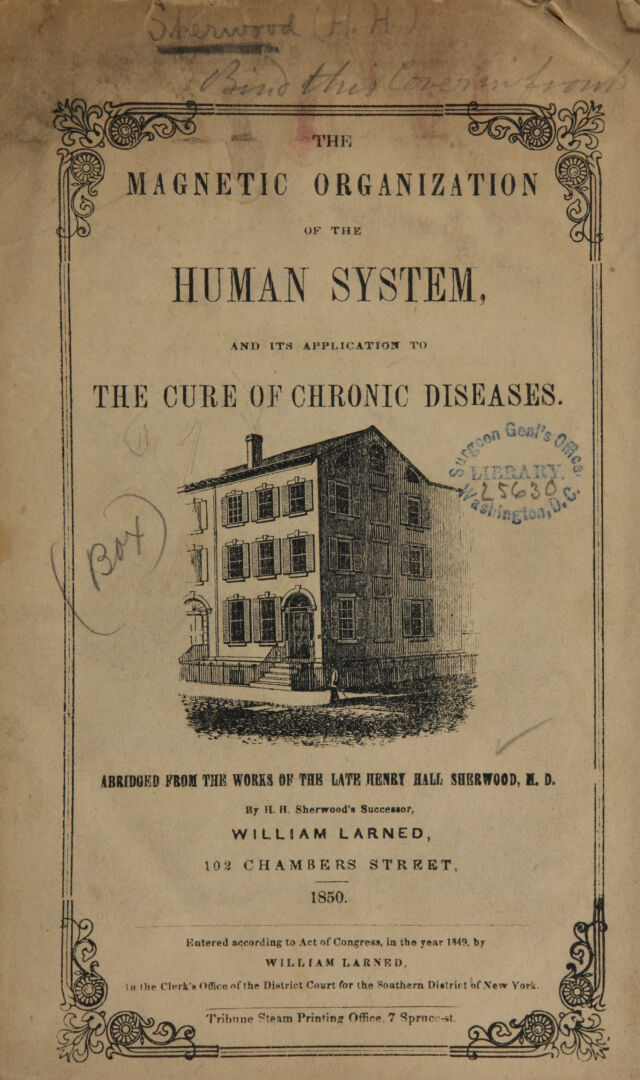
The magnetic organization of the human system, and its application to the cure of chronic diseases / abridged from the works of the late Henry Hall Sherwood by H.H. Sherwood's successor William Larned.
- Sherwood, H. H. (Henry Hall)
- Date:
- 1850
Licence: Public Domain Mark
Credit: The magnetic organization of the human system, and its application to the cure of chronic diseases / abridged from the works of the late Henry Hall Sherwood by H.H. Sherwood's successor William Larned. Source: Wellcome Collection.
Provider: This material has been provided by the National Library of Medicine (U.S.), through the Medical Heritage Library. The original may be consulted at the National Library of Medicine (U.S.)
4/20
![laws of motion which are found to bo constantly in operation in the organization of the human system, are deduced new and invariable symptoms of those diseases which belong to the class, hypertrophy — or chronic swellings of the organs and limbs, and these laws of magnetic motion explain the causes of their phenomena. The effect of the common practice in this class of chronic diseases, has long been known to be either entirely inoperative in most cases, or positively injurious if cairied beyond the purpose of temporary pallia- 'tion. In this belief, which we deem to be that of all the most intelli- gent and learned of the medical faculty, Dr. Sherwood commenced the investigation of the primary phenomena of this class of diseases as early as the year 1809, and the result of his researches has been the discov- ery.of the new and unerring symptoms by which to distinguish this dis- ease in any of the organs or limbs, and the proper mode of applying a remedy, which has given to his peculiar practice the celebrity and success it has obtained. Upon a careful examination of all the organs of the body, as the brain, eyes, heart, lungs, liver, spleen, pancreas, kidney, cystis, uterus, stomach, and intestines, we find them all without exception covered with a kind of skin called a serous membrane, in which is enclosed an incalculable number of minute glands or elementary organs, with ducts terminating in open orifices on the surface of these membranes, liko those of the common covering of the body. The glands of both struc- tures are found on examination of the orifices, of these ducts to excrete an aqueous or watery fluid, by which these surfaces are constantly maintained in a humid or moist state. The great quantity of this fluid Keen running oft' from the skin, and its accummulation in the cavities containing the organs, when these glands are excited to inordinate action, attest both the perfection of their mechanism and their fitness for their specific use. If we now proceed to examine the membrane which lines the interna] parts of the body, we shall find it, with slight modifications, character- ized by the same structure as the serous membranes which we ha7e described This modification principally consists in its having a villous instead of a serous surface, like the serous membranes. We find the whole track of the alimentary canal, including the mouth, oesophagus, stomach, and intestines, lined with this membrane, as well as the inter- nal parts of every organ, including even the ventricles cf the brain. On a minute examination of the structure of these internal membranes, which we shall term the mucous membranes to distinguish them from the serous or external membranes, we find them, like the latter, inclosing a great number of little glands or villi, as they are termed, having, like the papillary glands of the skin, their appropriate arteries, veins, and ducts terminating with open orifices on the surface. They are further characterized by numerous little cavities, crypts, or follicles, which have more or less a spheriodal shape, and which also open upon tue surface of these membranes. These ducts and follicles are found to be filled with a semi-fluid, or mucus, which is constantly issuing from then, and which spreads upon these membranous surfaces. In pursuing this subject, we have thus found two different kinds of surfaces in the organization of the body, disposed in two different ways, ind covered with two different kinds of fluids. We find also that the](https://iiif.wellcomecollection.org/image/b21153759_0004.jp2/full/800%2C/0/default.jpg)