Report of the Tuberculosis Commission : presented to both Houses of Parliament by command of His Excellency the Governor-General.
- South Africa. Tuberculosis Commission.
- Date:
- 1914
Licence: In copyright
Credit: Report of the Tuberculosis Commission : presented to both Houses of Parliament by command of His Excellency the Governor-General. Source: Wellcome Collection.
359/390 (page 341)
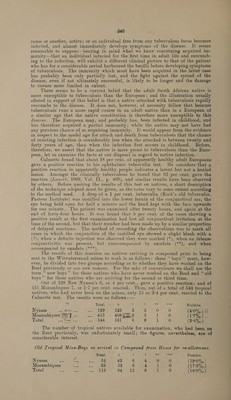
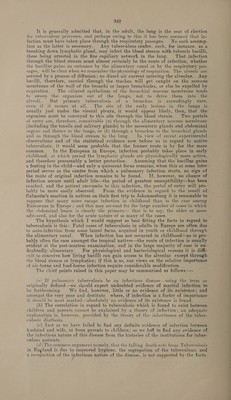
![It will be noticed that 18 per cent. gave a positive reaction, which is exactly the percentage found by Calmette in the Kuropean adult population. These results for natives are based on small numbers, and therefore subject to a large probable error, which in the last example is approximately 2-6 per cent. We can, however, say with certainty that a much higher percentage of ‘‘ boys’’ who have worked previously on the mines, give a positive reaction than is the case amongst those tropical natives from the same districts—who are arriving for the first time. Tropical Natives Returning Home after only one trip to Johannesburg. Total, 0 ? 5 ¥% AX* Positive, Total nek she coh et oe 105.) EE ls 2 0 (198%...) Tt is interesting to note that although a considerable number of natives are constantly returning home suffering from tuberculosis, yet the percentage of ‘‘ new boys” reacting to Calmette is very low when compared with that found amongst ‘““boys’’ who have worked previously on the Reef. Another point of considerable interest in reltaion to tuberculosis amongst mine natives is brought out by a study of the post-mortem records. Any one who has systematically carried out post-mortem examinations on natives from the mines, dying from tuberculosis, cannot but have been struck with the frequency of abdominal lesions. I have been able to construct the following tables from 201 consecutive post-mortems of natives dying from tuberculosis. These tables give the distribution of the organs affected with macroscopic tuberculosis : — | Organs Affected. Cause of Death, as certified ~~ i) to Register. Lungs | | § ra Perit- | . | Cases, | Lungs, ania Liver, Spleen. Fs & rab h Kidney. al organ. | | & fe) Bi i eee a ) j | Silicosis and Pulmonary | . Tuberculosis .. wont soe 37 20 Girisia8 15 2 — Pulmonary Tuberculosis 88 88 60 Lich, 26 49 9 1 General Tuberculosis ..| 39 39 39 28a 4h - 3d 29 13 5 All Deaths from Tuber- 164 141 | 113 | 62 80 | 108 38). 1] eulosis other than those 100 86 69 38 = 49 66 23 ff complicated by Silicosis | | | | ded (percentage). | fete | | | Out of the 27 cases complicated by silicosis the lung was the only organ found affected in 17, or 46 per cent. of the post-mortems. This group forms a class by itself, for all the natives composing it must have spent some, and possibly many years on the Rand; and are not, therefore, comparable wtih those who have been only a comparatively short time exposed to the influences of life on the mines. Out of the 88 natives certified as dying from pulmonary tuberculosis, 68 per cent. had some obvious abdominal lesion. Out of the total number of deaths from tuberculosis uncomplicated with silicosis, only in 28 cases were the lungs the only organ found affected, and in 238 of the total cases the lungs were not apparently involved. That is to say in rather over 80 per cent. of the cases some abdominal organ as well as the lung was tuberculous; and in 14 per cent. of all the cases the lung was not diseased. Out of 1,000 post-mortems referred to by Sir W. Osler, 275 showed active tuberculous lesions, in 272 cases the lungs were affected, and the percentage of cases in which the abdominal organs were diseased was as follows: Liver, 4:3 per cent.; spleen, 8-4 per cent.; peritoneum, 13 per cent.; kidneys, 11-6 per cent. ; and the intestines 23 per cent. The infection of the intestines was probably chiefly due to a secondary tuberculosis ulceration, caused by the swallowing of tuber- culous sputum. This condition is very rarely found in native post-mortems, and no case occurred in the 201 cases here dealt with. If these figures can be taken as representative of Huropean tuberculosis post-mortems, it is apparent that the Fast Coast and tropical native is much more prone to exhibit abdominal lesions, especially if we exclude intestinal ulceration as due to a late secondary infection. [U.G. 3414.)](https://iiif.wellcomecollection.org/image/b32184207_0359.jp2/full/800%2C/0/default.jpg)