Tuberculosis : its nature, prevention and treatment with special reference to the open air treatment of phthisis / by Alfred Hillier.
- Date:
- 1900
Licence: In copyright
Credit: Tuberculosis : its nature, prevention and treatment with special reference to the open air treatment of phthisis / by Alfred Hillier. Source: Wellcome Collection.
Provider: This material has been provided by the Royal College of Physicians of Edinburgh. The original may be consulted at the Royal College of Physicians of Edinburgh.
47/283 page 25
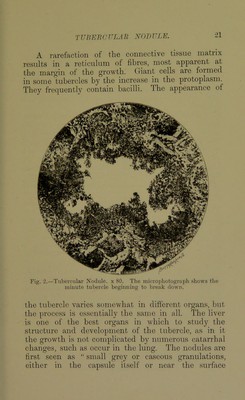
![MlLTAn Y TUBEliOULOSTS. than in any other form of tuberculosis. The etiology of the disease was described in the resume of Koch’s researches given in the last chapter (p. 8). In- fection in the great majority of cases is an auto- infection arising from tuberculous matter being introduced directly into the blood stream or, in more rare cases, into the thoracic duct. From tuber- culous glands, bones, or lungs, or from any other tuberculous focus, ulceration into a vein inay occur, and, by introducing the bacilli into the circulation, set up the disease. The tracheal and bronchial glands are perhaps the most common sources of d’igin, but It is not always possible to trace the course and history of the invasion. For clinical purposes miliary tuberculosis may be divided into (1) acute general infection, (2) cases with marked ]5ulmonary symptoms, and (8) cases with cerebral symptoms. The acute general infection closely resembles typhoid fever. The temperature is more irregular, and the characteristic typhoid spots are absent, although red spots do occur. The spots do not, however, appear in crops, and lack the characters of the typhoid eruption. Acute general tuberculosis may at any stage develop the pulmonary or menin- geal form, or may terminate, Avithout either of these being pronounced, in general torpor, coma, and death. Pulmonary Form.—Miliary Tuberculosis of the Lungs.—While infection in acute miliary tubercidosis may arise from any breaking down of tuberculous deposit, there is little doubt that in the pulmonary form of the disease an old deposit in the lung itself is usually the focus from Avhich the infection is derived. Thus Kingston-Fowler recorded a case'* in Avhich a caseous mass at the apex of the left lung, * “ rroceedings of the Royal Medico-Chi. Soc.” Series III., vol. viii., page 48.](https://iiif.wellcomecollection.org/image/b21988614_0047.jp2/full/800%2C/0/default.jpg)