Tuberculosis : its nature, prevention and treatment with special reference to the open air treatment of phthisis / by Alfred Hillier.
- Date:
- 1900
Licence: In copyright
Credit: Tuberculosis : its nature, prevention and treatment with special reference to the open air treatment of phthisis / by Alfred Hillier. Source: Wellcome Collection.
Provider: This material has been provided by the Royal College of Physicians of Edinburgh. The original may be consulted at the Royal College of Physicians of Edinburgh.
58/283 page 36
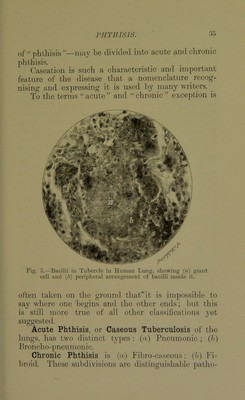
![’ - -1 1 11 1.1 1 .1 conditions may co-exist in the same lung. The source of the mischief in all forms is, of course, the tubercle bacillus, which, in connection with its ty])ical lesion, the tubercle, excites infiltration and proliferation of cells, leading in varying extent to caseation, calcification, and sclerosis. The different degrees to which one, or more, of these ])rocesses obtain determine the type of the disease. IMixed infection, due to the introduction of septic micrococci, also constitutes in the stages of softening and cavity formation an important element in the disease. Acute Phthisis, or Caseous Tuberculosis of the Lungs.—Clalloping consmnj)tion is, among all the various terms applied to tliis form of phthisis, the most familiar, and, at least, has this to commend it airse which the disease phthisis, epithelial pneumonia, etc., are terms also used. The two types of acute phthisis are pneu- monic and broncho-pneumonic, and the two together do not constitute more than 10 per cent, of the total number of phthisical cases. (a) The Pneumonic Type.—This form is not common, and when it occurs is not infrequently taken for pneumonia. One lobe, or, in some ca.ses, the whole lung, is affected. On section, the appear- ance is not unlike that of rod hepatisation, although on clo.se inspection miliary tubercles can generally be made out. A case of this typo may run a very acute cour.se terminating in less than a month; more commonly it lasts for three or four months, when caseation and cavities occur. The onset is usually sudden, and accompanied by a rigor. The temperature ri.sos and continues high. Dyspncea soon sets in, with pain in the side, cough. more phthisis, scrofulous](https://iiif.wellcomecollection.org/image/b21988614_0058.jp2/full/800%2C/0/default.jpg)