Tuberculosis : its nature, prevention and treatment with special reference to the open air treatment of phthisis / by Alfred Hillier.
- Date:
- 1900
Licence: In copyright
Credit: Tuberculosis : its nature, prevention and treatment with special reference to the open air treatment of phthisis / by Alfred Hillier. Source: Wellcome Collection.
Provider: This material has been provided by the Royal College of Physicians of Edinburgh. The original may be consulted at the Royal College of Physicians of Edinburgh.
68/283 page 42
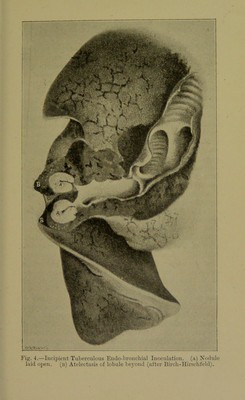
![llio other apex, and travel Irom there downwards. Ivingston Fowler has traced a certain course which the disease usually follows. The initial lesion, as a rule, is from an inch to an inch and a half below the suimnit of the lung, and near the external and pos- terior borders, and may generally bo detected b}- auscultation in the supra-spinous fossa before it is recognisable in front. Anteriorly, this focus corre- sponds to a spot just below the middle of the clavicle, and as it extends along, the anterior aspect of the upper lobe may be detected in a line about an inch and a half from the inner ends of the iirst three interspaces. By the time the disease is clinically re- cognisable in the upper lobe, the lower lobe, as a rule, has been invaded. The commonest spot for invasion hero is about an inch to an inch and a half below the posterior extremity of the apex, and the best site for detecting it by auscultation a spot opposite the fifth dorsal spine. From these observations it is evident hoAv im- portant the careful ]iostcrior auscultation of the apex IS in early ca.ses of phthisis. At the same time, the course followed is frequently a considerable modifica- tion of the above, and the one broad fact of real, practical value is that the invasion is almost always near the apex. I’ercy Kidd estimates the proportion of apical to basic primary lesions in phthisis as 500 to 1. It is, however, quite common, wncre the disease is of any duration, to find arrested lesions of the apex and more recent ones in the base. Cavities are all produced by ulceration and neero.sis, but diHer very much in character, size, con- tents, and the constitution of their walls. Fridges or trabecul.e of lung tissue are often found in cavities, and consist usually of partially obliterated vessels and strands of fibrous cand ela.stic tissue to which more or less pulmonary tissue in various stages of <lis-](https://iiif.wellcomecollection.org/image/b21988614_0068.jp2/full/800%2C/0/default.jpg)