Old English plate, ecclesiastical, decorative, and domestic : its makers and marks / by Wilfred Joseph Cripps.
- Wilfred Joseph Cripps
- Date:
- 1899
Licence: Public Domain Mark
Credit: Old English plate, ecclesiastical, decorative, and domestic : its makers and marks / by Wilfred Joseph Cripps. Source: Wellcome Collection.
59/514 page 35
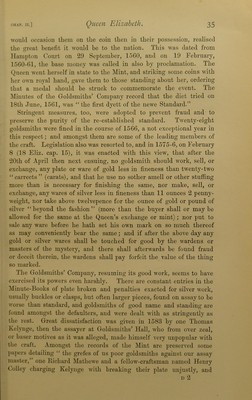
![would occasion them on the coin then in their possession, realised the great benefit it would bo to the nation. This was dated from Hampton Court on 29 September, 1560, and on 19 February, 1560-61, the base money was called in also by proclamation. The Queen went herself in state to the Mint, and striking some coins with her OAvn royal hand, gave them to those standing about her, ordering that a medal should be struck to commemorate the event. The Minutes of the Goldsmiths’ Company record that the diet tried on 18th June, 1561, Avas “ the first dyett of the newe Standard.” Stringent measures, too, were adopted to prevent fraud and to preserve the purity of the re-established standard. Twenty-eight goldsmiths were fined in the course of 1566, a not exceptional year in this respect; and amongst them are some of the leading members of the craft. Legislation also was resorted to, and in 1575-6, on February 8 (18 Eliz. cap. 15), it Avas enacted with this view, that after the 20th of April then next ensuing, no goldsmith should AA^ork, sell, or exchange, any plate or Avare of gold less in fineness than twenty-two “carrects ” (carats), and that he use no sother amell or other stuffing more than is necessary for finishing the same, nor make, sell, or exchange, anyAA^ares of silver less in fineness than 11 ounces 2 penny- AA’eight, nor take aboA^e twelvepence for the ounce of gold or pound of silver “beyond the fashion” (more than the buyer shall or may be allowed for the same at the Queen’s exchange or mint); nor put to sale any ware before he hath set his own mark on so much thereof as may conveniently bear the same; and if after the above day any gold or silver wares shall be touched for good by the wardens or masters of the mystery, and there shall afterwards be found fraud or deceit therein, the wardens shall pay forfeit the value of the thing so marked. The Goldsmiths’ Company, resuming its good work, seems to have exercised its poAvers even harshly. There are constant entries in the Minute-Books of plate broken and penalties exacted for silver Avork, usually buckles or clasps, but often larger pieces, found on assay to be AA'orse than standard, and goldsmiths of good name and standing are found amongst the defaulters, and Avere dealt Avith as stringently as the rest. Great dissatisfaction was given in 1583 by one Thomas Kelynge, then the assayer at Goldsmiths’ Hall, Avho from over zeal, or baser motives as it was alleged, made himself very unpopular Avith the craft. Amongst the records of the Mint are preserved some ])apers detailing “ the grefes of us poor goldsmiths against our assay master,” one Richard Mathewe and a fellow-craftsman named Henry Colley charging Kelynge Avith breaking their plate unjustly, and](https://iiif.wellcomecollection.org/image/b24855273_0061.jp2/full/800%2C/0/default.jpg)
 No text description is available for this image
 No text description is available for this image
 No text description is available for this image