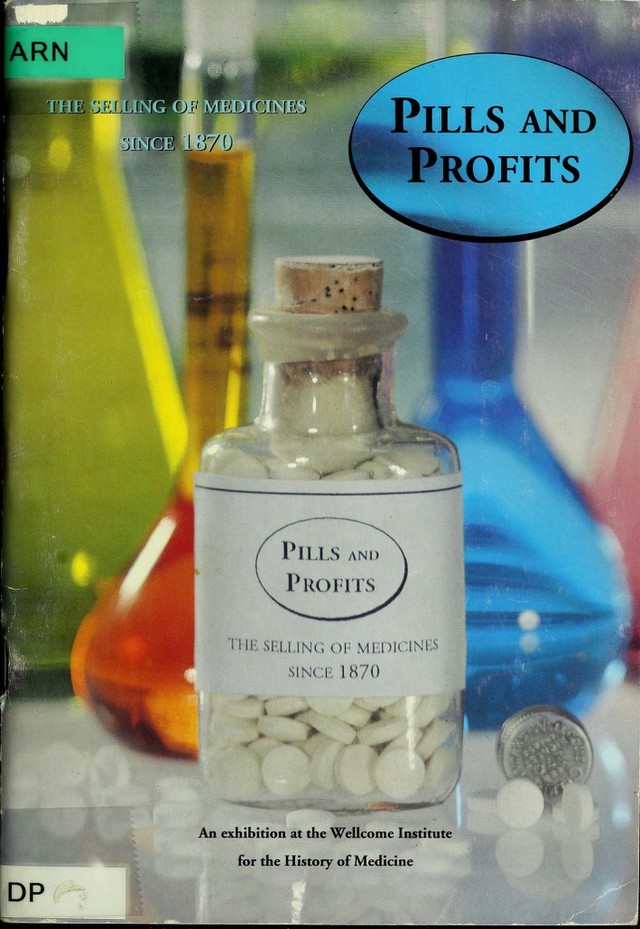
Pills and profits : the selling of medicines since 1870 : an exhibition at the Wellcome Institute for the History of Medicine / Ken Arnold, Tilli Tansey.
- Arnold, Ken, 1960-
- Date:
- 1994
Licence: Attribution 4.0 International (CC BY 4.0)
Credit: Pills and profits : the selling of medicines since 1870 : an exhibition at the Wellcome Institute for the History of Medicine / Ken Arnold, Tilli Tansey. Source: Wellcome Collection.
37/64 page 35
![11.6 'Kamame Pink Oil' and 'Kamame Bitters'. Medicine boxes; Canadian, [1890?] These boxes come from a collection of medical material gathered by James Kasper, one of the Sequah Ltd medicine men. Though claiming to produce its successful Eastern medicines in Bombay, the Kamame Medicine Co. was actually based in Windsor, Ontario. Bitters, it was claimed, had found its way through the hands of missionaries into the darkest and farthest parts of Africa, and this without advertis- ing. The Kamame company were involved in the introduction of Sequah into Canada. CMAC GC/69/6A 11.7 'Notice. This is Sequah's last week in Georgetown'; Georgetown, [189-]. Kasper's Georgetown Scrapbook, 1890-91 The handbill was produced for the visit of James Kasper working as a Sequah medi- cine man in Georgetown, Demerara (Guyana). Other Sequahs operated in Cape Town, Uruguay and much of Europe. The anonymous caricature appeared in a local paper Argosy (2 May 1891). In the engraving, Kasper holds a bottle of Sequah medi- cine, while in the background local doctors leave town for lack of business and the hospital is put up to let. One of the more remarkable aspects of the Sequah story is how an English firm managed to export 'Indian' remedies to the Americas. GC/69/9 11.8 Sequah's Annual, English, 1890. Sequah Speaks; English, [1890?] The Sequah company produced a considerable number of promotional pamphlets. The items in the Annual were typical: half of it is taken up with an article 'The Manitou's Message: A reminiscence of the Prairies' about travelling in Montana. This sort of material helped create the cultural context (often identified with a famous Indian tribes) from which the Sequah products were meant to emanate. The rest of the Annual is taken up with Sequah advertisements and testimonials and a caution about unscrupulous persons adopting Sequah's method of advertising. CMAC GC/69/7 11.9 Sequah's Annual; English, 1891 Priced at two pence, this annual contained, amongst other items, a short story by Wilkie Collins and a cartoon strip: 'The Tale of a Pig'. Sprinkled throughout are also announcements and advertisements for Sequah products. Under the heading 'True Philosophy', 'Prairie Flower' is described as consisting of Californian and American spring waters combined with botanic extracts. CMAC GC/69/11](https://iiif.wellcomecollection.org/image/b20456517_0037.jp2/full/800%2C/0/default.jpg)