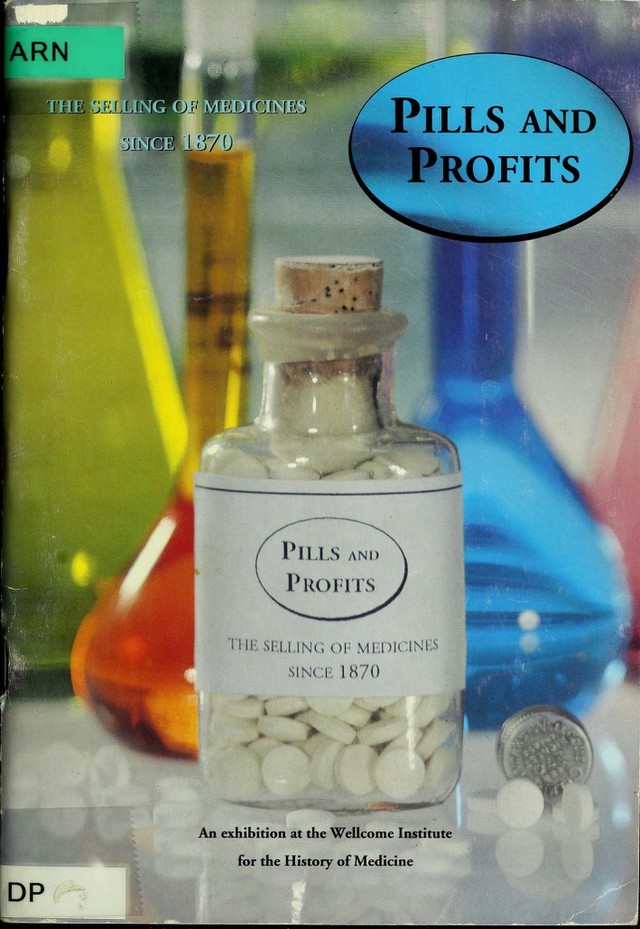
Pills and profits : the selling of medicines since 1870 : an exhibition at the Wellcome Institute for the History of Medicine / Ken Arnold, Tilli Tansey.
- Arnold, Ken, 1960-
- Date:
- 1994
Licence: Attribution 4.0 International (CC BY 4.0)
Credit: Pills and profits : the selling of medicines since 1870 : an exhibition at the Wellcome Institute for the History of Medicine / Ken Arnold, Tilli Tansey. Source: Wellcome Collection.
41/64 page 39
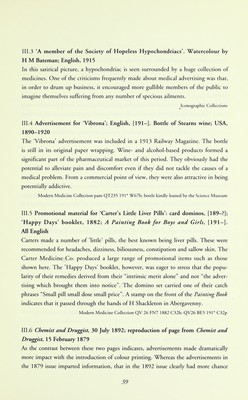
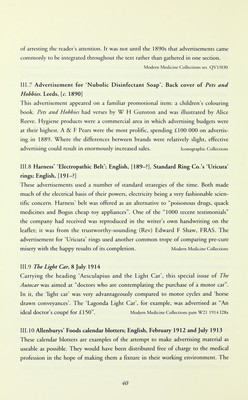
![111.3 'A member of the Society of Hopeless Hypochondriacs'. Watercolour by H M Bateman; English, 1915 In this satirical picture, a hypochondriac is seen surrounded by a huge collection of medicines. One of the criticisms frequently made about medical advertising was that, in order to drum up business, it encouraged more gullible members of the public to imagine themselves suffering from any number of specious ailments. Iconographic Collections 111.4 Advertisement for 'Vibrona'; English, [191-]. Bottle of Stearns wine; USA, 1890-1920 The 'Vibrona' advertisement was included in a 1913 Railway Magazine. The bottle is still in its original paper wrapping. Wine- and alcohol-based products formed a significant part of the pharmaceutical market of this period. They obviously had the potential to alleviate pain and discomfort even if they did not tackle the causes of a medical problem. From a commercial point of view, they were also attractive in being potentially addictive. Modern Medicine Collection pam QT235 191* W67b; bottle kindly loaned by the Science Museum 111.5 Promotional material for 'Carter's Little Liver Pills': card dominos, [189-?]; 'Happy Days' booklet, 1882; A Painting Book for Boys and Girls, [191-]. All English Carters made a number of 'little' pills, the best known being liver pills. These were recommended for headaches, dizziness, biliousness, constipation and sallow skin. The Carter Medicine Co. produced a large range of promotional items such as those shown here. The 'Happy Days' booklet, however, was eager to stress that the popu- larity of their remedies derived from their intrinsic merit alone and not the adver- tising which brought them into notice. The domino set carried one of their catch phrases Small pill small dose small price. A stamp on the front of the Painting Book indicates that it passed through the hands of H Shackleton in Abergavenny. Modern Medicine Collection QV 26 FN7 1882 C32h; QV26 BE5 191* C32p 111.6 Chemist and Druggist, 30 July 1892; reproduction of page from Chemist and Druggist, 15 February 1879 As the contrast between these two pages indicates, advertisements made dramatically more impact with the introduction of colour printing. Whereas the advertisements in the 1879 issue imparted information, that in the 1892 issue clearly had more chance](https://iiif.wellcomecollection.org/image/b20456517_0041.jp2/full/800%2C/0/default.jpg)