Pills and profits : the selling of medicines since 1870 : an exhibition at the Wellcome Institute for the History of Medicine / Ken Arnold, Tilli Tansey.
- Arnold, Ken, 1960-
- Date:
- 1994
Licence: Attribution 4.0 International (CC BY 4.0)
Credit: Pills and profits : the selling of medicines since 1870 : an exhibition at the Wellcome Institute for the History of Medicine / Ken Arnold, Tilli Tansey. Source: Wellcome Collection.
42/64 page 40
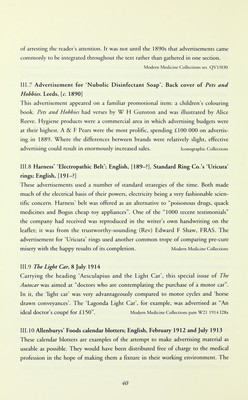
![of arresting the reader's attention. It was not until the 1890s that advertisements came commonly to be integrated throughout the text rather than gathered in one section. Modern Medicine Collections ser. QV1/030 111.7 Advertisement for 'Nubolic Disinfectant Soap'. Back cover of Pets and Hobbies. Leeds, [c. 1890] This advertisement appeared on a familiar promotional item: a children's colouring book. Pets and Hobbies had verses by W H Gunston and was illustrated by Alice Reeve. Hygiene products were a commercial area in which advertising budgets were at their highest. A & F Pears were the most prolific, spending £100 000 on advertis- ing in 1889. Where the differences between brands were relatively slight, effective advertising could result in enormously increased sales. Iconographic Collections 111.8 Harness' 'Electropathic Belt'; English, [189-?]. Standard Ring Co.'s 'Uricura' rings; English, [191-?] These advertisements used a number of standard strategies of the time. Both made much of the electrical basis of their powers, electricity being a very fashionable scien- tific concern. Harness' belt was offered as an alternative to poisonous drugs, quack medicines and Bogus cheap toy appliances. One of the 1000 recent testimonials the company had received was reproduced in the writer's own handwriting on the leaflet; it was from the trustworthy-sounding (Rev) Edward F Shaw, FRAS. The advertisement for 'Uricura' rings used another common trope of comparing pre-cure misery with the happy results of its Completion. Modern Medicine Collections 111.9 The Light Car, 8 July 1914 Carrying the heading 'Aesculapius and the Light Car', this special issue of The Autocar was aimed at doctors who are contemplating the purchase of a motor car. In it, the 'light car' was very advantageously compared to motor cycles and 'horse drawn conveyances'. The 'Lagonda Light Car', for example, was advertised as An ideal doctor's coupe for £1 50. Modern Medicine Collections pam W21 1914 I28a III. 10 Allenburys' Foods calendar blotters; English, February 1912 and July 1913 These calendar blotters are examples of the attempt to make advertising material as useable as possible. They would have been distributed free of charge to the medical profession in the hope of making them a fixture in their working environment. The](https://iiif.wellcomecollection.org/image/b20456517_0042.jp2/full/800%2C/0/default.jpg)