A medical handbook : for the use of practitioners and students / by R.S. Aitchison.
- Aitchison, R. S. (Robert Swan)
- Date:
- 1893
Licence: Public Domain Mark
Credit: A medical handbook : for the use of practitioners and students / by R.S. Aitchison. Source: Wellcome Collection.
19/368 page 3
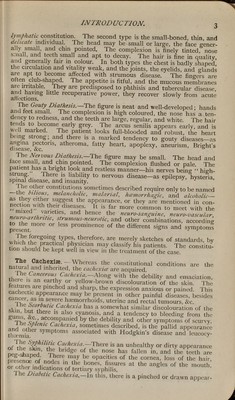
![lymphatic constitution. The second type is the small-boned, thin, and delicate individual. The head may be small or large, the face gener¬ ally small, and chin pointed. The complexion is finely tinted, nose small, and teeth small and apt to decay. The hair is fine in quality and generally fair in colour. In both types the chest is badly shaped] the circulation and vitality weak, and the joints, the eyelids, and <dands are apt to become affected with strumous disease. The fingers are often club-shaped. The appetite is fitful, and the mucous membranes are irritable They are predisposed to phthisis and tubercular disease and having little recuperative power, they recover slowly from acute affections. The Gouty Diathesis.— The figure is neat and well-developed; hands and feet small. The complexion is high coloured, the nose has a ten¬ dency to redness, and the teeth are large, regular, and white. The hair tends to become early grey. The arcus senilis appears early, and is well marked. The patient looks full-blooded and robust, the heart being strong; and there is a marked tendency to gouty diseases—as angina pectoris, atheroma, fatty heart, apoplexy, aneurism, Bright's disease, &c. > & The Netvous Diathesis.—The figure may be small. The head and lace small, and chin pointed. The complexion flushed or pale. The patient has a bright look and restless manner—his nerves being “high- strung There is liability to nervous disease—as epilepsy, hysteria spinal disease, and insanity. 1 /,lic Pl.he' constitutions sometimes described require only to be named the bilious, melancholic, malarial, hamorrhagic, and alcoholic— “5“* e'ther suggest the appearance, or they are mentioned in con¬ nection with their diseases. It is far more common to meet with the w ™s' and hence the neuro-sanguine, neuro-vascular, ncuio-cuthritic, strumous-neurotic, and other combinations, according present.nl°re ^ prom,nence of ‘he different signs and symptoms w foregoing types, therefore, are merely sketches of standards, by t on shnm ,p,rac.,Ca ph,TS,Clan ma>' c'assify his patients. The constitu¬ tion should be kept well in view in the treatment of the case. n Tf® Cachexia.--Whereas the constitutional conditions are the natural and inherited, the cachexia are acquired. ^ Cancerous Cachexia.—A\ox\% with the debility and emaciation, tnere is an earthy or yellow-brown discolouration of the skin. The aref.are p,nchcd and sharp, the expression anxious or pained. This “ ™lc appearance may be present in other painful diseases, besides I lf ' <. Scvcrc haemorrhoids, uterine and rectal tumours, &c. C“cfoxia has a somewhat similar discolouration of the “ ”'c * there 1S als? cyanosis, and a tendency to bleeding from the g -r, ' cfV aFc°mPanled by the debility and other symptoms of scurvy an fZ. Cachexia, sometimes described, is the pallid appearance tlm-mia Symptoms ass°ciated with Hodgkin's disease and leucocy- of the 'sWn‘“lb ^aff^--There is an unhealthy or dirty appearance nee-shaned’ Th bndgC ° thc n0Se has fallcn in' aad the teeth are Z m?y ,JC opac‘tlcs of thc cornea, loss of the hair, w otZffind,vf .dCS 'V'c .bones, fissures at the angles of the mouth, or otner indications of tertiary syphilis. I he Diabetic Cachexia.—In this, there is a pinched or drawn appear-](https://iiif.wellcomecollection.org/image/b29343628_0019.jp2/full/800%2C/0/default.jpg)



 No text description is available for this image
 No text description is available for this image
 No text description is available for this image