Recent improvements in methods for the biological purification of sewage / by W.J. Dibdin.
- William Joseph Dibdin
- Date:
- 1907
Licence: In copyright
Credit: Recent improvements in methods for the biological purification of sewage / by W.J. Dibdin. Source: Wellcome Collection.
Provider: This material has been provided by London School of Hygiene & Tropical Medicine Library & Archives Service. The original may be consulted at London School of Hygiene & Tropical Medicine Library & Archives Service.
76/98 (page 52)
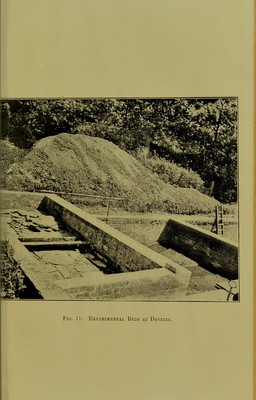
![of slate. As now arranged, tlie water capacity of a new bod is about 87 jjer cont. of the total cubic content of the tank up to the level of tht; top layer of slate. The whole of the sewage of the town was turned on to the now instalk- tion on September 12th, 1905, with the results of entirely confirming the above oxporieiicos with the experimental beds. [The analytical results obtained will be seen in Table (Third Series) on next page.] The effluent from the fine bod is then discharged on to land. The deposit from the slato beds has been allowed to flow on to the surface of the fine beds and there collected in channels, from whence it is removed and thrown up in heaps on the surface of the fine beds t<j undergo weathering after which it is again spread out on the surface of the bed. In future installations arrangements will be made for thi.s matter being discharged on to a special area of ashes or similar material, so as to keep the surface of the fine beds as open as possible. I'lxperimental trials of the xise of the slate have also been made by Ihc- Corporation of Trowbridge, who, however, placed the efiiuent from a septic tank upon them as well as on beds filled with gi-anite, sandstone, coke and other material. The analyses of the respective effluents were made by Mr. Waterfall, F.I.C., &c., of Bristol, who reported that in either case slate gave the best results, and as a result the Corporation are filling one half of the primary beds with that material. Slate beds are also in operation at the works at High Wycombe for the purpose of eliminating the sludge difficulty, the effluent from these being discharged dii-ect on to the land with satisfactory results. Erom these various results it is evident that the suggestion to use beds filled with layers of slate divided by distance pieces has been justified, and that the method, although doubtless subject to improvement, deals effectually vsdth the sludge difficulty, and renders the sewage fit for the further process of purification on either contact beds, sprinkling beds or on land when such is obtainable of suitable quality and quantitv. With regard to the discharge of sewage dii-ect into the sea, it is evident that the preliminary breaking up of the solid matters by inoffensive digestion on a slate bed would be an immense improvement over the common custom of sending it in with all the solid matters, which float along the coast and form offensive deposits on the shore, as I found to be the case in one instance where the whole of the foreshore for a con- siderable distance at low water was reeking with sulphuretted hydroscu, and the stones and rocks and many of the seaweeds coated with Begrjiatm alba, the well-known sewage fungus, whilst Bacillus coli coinmioiis was abundant in all the samples collected. Such a state of things could not arise if the sewage before its discharge had been subjected to preliminary aerobic action on such beds as described above.](https://iiif.wellcomecollection.org/image/b21358254_0078.jp2/full/800%2C/0/default.jpg)