Report on the geology of Cornwall, Devon and West Somerset / by Henry T. De La Beche, F.R.S., &c., director of the Ordnance geological survey. Pub. by order of the Lords commissioners of Her Majesty's Treasury.
- Henry De la Beche
- Date:
- 1839
Licence: Public Domain Mark
Credit: Report on the geology of Cornwall, Devon and West Somerset / by Henry T. De La Beche, F.R.S., &c., director of the Ordnance geological survey. Pub. by order of the Lords commissioners of Her Majesty's Treasury. Source: Wellcome Collection.
675/714 (page 635)
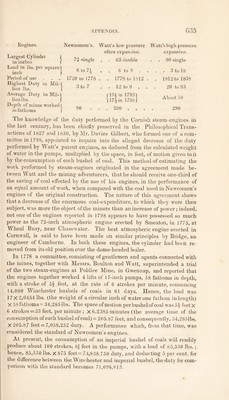
![Engines. Newcomen’s. Watt’s low pressure Watt’s high pressure Largest Cylinder ) in inches j often expansive. expansive. 72 single , . 63 double . . 90 single Load in lbs. per square] inch j 1 6 to 7i , . 6 to 9 . . 3 to 18 Period of use 1720 to 1778 . . 1778 to 1812 . . 1812 to 1838 Highest Duty in Mil-i lion lbs. j- 3 to 7 . . 12 to 9 20 to 93 Average Duty in Mil-] lion lbs. j j19| in 1793) \17|in 1798/ About 50 Depth of mines worked i in fathoms ] [■ 90 . . . 200 . . . 290 The knowledge of the duty performed by the Cornish steam-engines in the last century, has been chietiy preserved in the Philosophical Trans- actions of 1827 and 1830, by Mr. Davies Gilbert, who formed one of a com- mittee in 1798, appointed to inquire into the alleged decrease of the duty performed by Watt’s patent engines, as deduced from the calculated weight of water in the pumps, multiplied by the space, in feet, of motion given to it by the consumption of each bushel of coal. This method of estimating the work performed by steam-engines originated in the agreement made be- tween Watt and the mining adventurers, that he should receive one-third of the saving of coal effected by the use of his engines, in the performance of an equal amount of work, when compared with the coal used in Newcomen’s engines of the original construction. The nature of this agreement shows that a decrease of the enormous coal-expenditure, to which they were then subject, was more the object of the miners than an increase of power ; indeed, not one of the engines reported in 1798 appears to have possessed so much power as the 72-inch atmospheric engine erected by Smeaton, in 1775, at Wheal Busy, near Chasewater. The best atmospheric engine erected in Cornwall, is said to have been made on similar principles by Bridge, an engineer of Camborne. In both these engines, the cylinder had been re- moved from its old position over the dome-headed boiler. In 1778 a committee, consisting of gentlemen and agents connected with the mines, together with Messrs. Boulton and Watt, superintended a trial of the two steam-engines at Poldice Mine, in Gwennap, and reported that the engines together worked 4 lifts of 1 7-inch pumps, 58 fathoms in depth, with a stroke of 5^ feet, at the rate of 6 strokes per minute, consuming 14,080 Winchester bushels of coals in 61 days. Hence, the load was 17 X 2,0454 lbs. (the weight of a circular inch of water one fathom in length) X 58 fathoms = 34,285 lbs. The space of motion per bushel of coal was 5^ feetx 6 strokes = 33 feet, per minute ; X 6.2385 minutes (the average time of the consumption of each bushel of coal) = 205.87 feet, and consequently, 34,285lbs. X 205.87 feet = 7,058,252 duty. A performance which, from that time, was considered the standard of Newcomen's engines. At present, the consumption of an imperial bushel of coals will readily produce about 100 strokes, 8| feet in the pumps, with a load of 85,530 lbs. ; hence, 85,530 lbs. X 875 feet = 74,838,750 duty, and deducting 5 per cent, for the difference between the Winchester and imperial bushel, the duty for com- parison with the standard becomes 71,096,813.](https://iiif.wellcomecollection.org/image/b29350864_0675.jp2/full/800%2C/0/default.jpg)