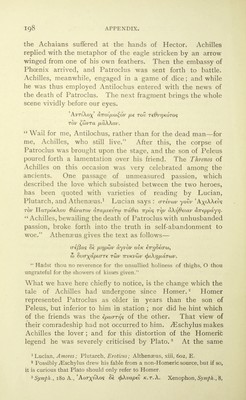
Studies in the psychology of sex. Vol. 1, Sexual inversion / by Havelock Ellis and John Addington Symonds / by Havelock Ellis.
- Havelock Ellis
- Date:
- 1897
Licence: Public Domain Mark
Credit: Studies in the psychology of sex. Vol. 1, Sexual inversion / by Havelock Ellis and John Addington Symonds / by Havelock Ellis. Source: Wellcome Collection.
219/324 page 199
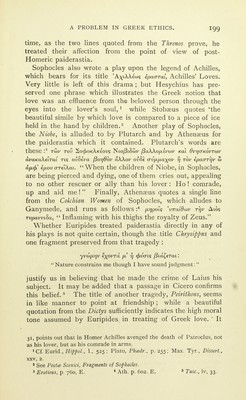
V avaKaXtLTai rts ovSlva j3or]06v aXkov ovSk o~vfxixa\ov rj tov ipao-rrjv u> d//,<£' ifAovo-tclXm. When the children of Niobe, in Sophocles, are being pierced and dying, one of them cries out, appealing to no other rescuer or ally than his lover : Ho ! comrade, up and aid me! Finally, Athenaeus quotes a single line from the Colchian Women of Sophocles, which alludes to Ganymede, and runs as follows :4 prjpols Wat&oi/ ttjv Atos TvpavviSa, Inflaming with his thighs the royalty of Zeus. Whether Euripides treated paiderastia directly in any of his plays is not quite certain, though the .title Chrysippus and one fragment preserved from that tragedy : yvwpvqv e^ovTtt pC rj <pvo-is /3ta£eTai: Nature constrains me though I have sound judgment: justify us in believing that he made the crime of Laius his subject. It may be added that a passage in Cicero confirms this belief.5 The title of another tragedy, Peivithons, seems in like manner to point at friendship ; while a beautiful quotation from the Dictys sufficiently indicates the high moral tone assumed by Euripides in treating of Greek love. ' It 31, points out that in Homer Achilles avenged the death of Patroclus, not as his lover, but as his comrade in arms. 1 Cf. Eurid., Hippol., 1., 525; Plato, Phcedr., p. 255; Max. Tyr., Dissert., XXV, 2. 2 See Poetce Scenici, Fragments of Sophocles.](https://iiif.wellcomecollection.org/image/b2041996x_0221.jp2/full/800%2C/0/default.jpg)