Essay 1 On malformations of the human heart : illustrated by numerous cases, and five plates containing fourteen figures; and preceded by some observations on the method of improving the diagnostic part of medicine / by J. R. Farre.
- John Richard Farre
- Date:
- 1814
Licence: Public Domain Mark
Credit: Essay 1 On malformations of the human heart : illustrated by numerous cases, and five plates containing fourteen figures; and preceded by some observations on the method of improving the diagnostic part of medicine / by J. R. Farre. Source: Wellcome Collection.
Provider: This material has been provided by Royal College of Physicians, London. The original may be consulted at Royal College of Physicians, London.
65/86 (page 31)
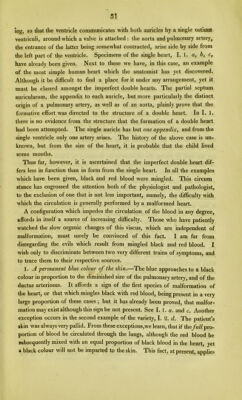
![ing, so that the ventricle communicates with both auricles by a single ostium ventriculi, around which a valve is attached : the aorta and pulmonary artery, the entrance of the latter being somewhat contracted, arise side by side from the left part of the ventricle. Specimens of the single heart, I. 1. a, b, c, have already been given. Next to these we have, in this case, an example of the most simple human heart which the anatomist has yet discovered. Although it be difficult to find a place for it under any arrangement, yet it must be classed amongst the imperfect double hearts. The partial septum auricularum, the appendix to each auricle, but more particularly the distinct origin of a pulmonary artery, as well as of an aorta, plainly prove that the formative effort was directed to the structure of a double heart. In I. 1. there is no evidence from the structure that the formation of a double heart had been attempted. The single auricle has but one appendix, and from the single ventricle only one artery arises. The history of the above case is un- known, but from the size of the heart, it is probable that the child lived some months. Thus far, however, it is ascertained that the imperfect double heart dif- fers less in function than in form from the single heart. In all the examples which have been given, black and red blood were mingled. This circum stance has engrossed the attention both of the physiologist and pathologist, to the exclusion of one that is not less important, namely, the difficulty with which the circulation is generally performed by a malformed heart. A configuration which impedes the circulation of the blood in any degree, affords in itself a source of increasing difficulty. Those who have patiently watched the slow organic changes of this vjscus, which are independent of malformation, must surely be convinced of this fact. I am far from disregarding the evils which result from mingled black and red blood. I wish only to discriminate between two very different trains of symptoms, and to trace them to their respective sources. 1. A permanent blue colour of the skin.—The blue approaches to a black colour in proportion to the diminished size of the pulmonary artery, and of the ductus arteriosus. It affords a sign of the first species of malformation of the heart, or that which mingles black with red blood, being present in a very large proportion of these cases ; but it has already been proved, that malfor- mation may exist although this sign be not present. See !.].«. and c. Another exception occurs in the second example of the variety, I. 2. d. The patient s skin was always very pallid. From these exceptions,we learn, that if the full pro- portion of blood be circulated through the lungs, although the red blood be subsequently mixed with an equal proportion of black blood in the heart, yet a black colour will not be imparted to the skin. This fact, at present, applies](https://iiif.wellcomecollection.org/image/b28034855_0065.jp2/full/800%2C/0/default.jpg)