The internal parasites of our domesticated animals : a manual of the Entozoa of the ox, sheep, dog, horse, pig, and cat / by T. Spencer Cobbold.
- Date:
- 1873
Licence: Public Domain Mark
Credit: The internal parasites of our domesticated animals : a manual of the Entozoa of the ox, sheep, dog, horse, pig, and cat / by T. Spencer Cobbold. Source: Wellcome Collection.
Provider: This material has been provided by the Royal College of Physicians of Edinburgh. The original may be consulted at the Royal College of Physicians of Edinburgh.
64/168 (page 50)
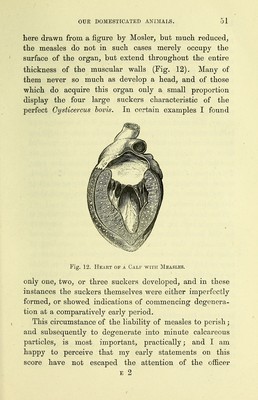
![tapeworm. Fortunately these people suffer less than we ourselves would do were we placed in like circum- stances and played the part of '^host^^ to the same extent; but this consideration in no wise lessens the value of the entozoological evidences thus afforded. It may be added also that_, as the Burates seldom eat pork^ it is nearly certain that most of their cestode guests belong to the species of tapeworm which is derived from eating veal and beef. The measles or cysticerci have a preference for the external muscles of animals,, selecting principally those of the shoulder and haunch. They are comparatively rare in the deep-seated muscles^ although I have found many of them in the diaphragm. An exception must also be made in favour of certain other muscles which help to form the walls of the abdominal cavity. Beef measles develop pretty freely in the loose cellular and fatty tissues; at least I have removed many from such situations. However^ in contradiction to my personal experiences^ Dr. Alexander Neill^ in the Madras Report already quoted (p. 107), states that ^^the larvse of Tmnia mediocanellata will only come to maturity in the mucous membrane, [and] not in the cellular tissue of horned cattle.''^ This assertion is not borne out by the facts noticed in my experimental calf, in which animal the connective tissues were invaded, especially in the regions of the so-called facia lumharis as well as in that of the Unea semicirGularis. Measles are also liable to take up their residence in the heart; but, probably on account of the density of the muscular substance of that organ, they do not acquire so large a size as elsewhere, and, according to my own examinations, very few of them become perfectly formed. As seen in the specimen](https://iiif.wellcomecollection.org/image/b21915453_0064.jp2/full/800%2C/0/default.jpg)