The organic constituents of plants and vegetable substances and their chemical analysis / by G.C. Wittstein ; authorised translation from the German original, enlarged with numerous additions, by Baron Ferd. von Mueller.
- Date:
- 1878
Licence: Public Domain Mark
Credit: The organic constituents of plants and vegetable substances and their chemical analysis / by G.C. Wittstein ; authorised translation from the German original, enlarged with numerous additions, by Baron Ferd. von Mueller. Source: Wellcome Collection.
Provider: This material has been provided by the Royal College of Physicians of Edinburgh. The original may be consulted at the Royal College of Physicians of Edinburgh.
64/362 page 40
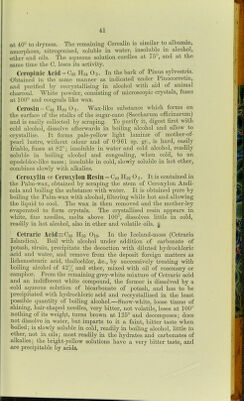
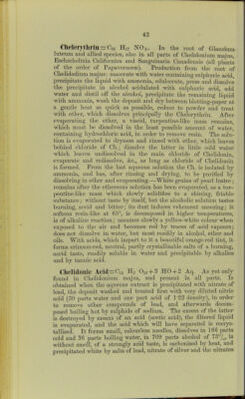
![duces no turbidity in a solution of glue, unless it be previously treated with nitric acid, whereby a brown substance is precipitated. CatecllU Tannic Acid. In the Catechu (see Catechin) [also in the bark of the Prickly Banksia of Western Australia.] Not known in the pure state; is a product of decomposition of catechuic acid (not the substance from which the latter is formed, as for- merly stated). Macerate the catechu with ether, agitate the solution with water, decant the ethereous liquid and evaporate to dryness; dissolve in water and allow the catechuic acid to crystallise. The mother-ley contains nearly pure Catechu tannic acid. It precipitates the salts of oxyd of iron with a dirty-green colour, also glue. Cedrill. The bitter ingredient of the fruit of Simaba Cedron. Remove a fatty substance by treating with ether, and dissolve the bitter substance by means of alcohol. White, silky needles, still more bitter than strychnin, little soluble in cold, readily in boil- ing water, of neutral reaction. Cellulose. See Fibrin. Centaurin = Cnicin. Ceradia BJesill = C40 H2s O4. From Othonna furcata. Amber- yellow, smells like elemi, has an acid reaction when dissolved in alcohol. Cerasiu. See Cherry Gum. Ceratopliyllin.* In Parmelia physoides [and probably also in other Parmelias]. Pour lime-water on the lichen washed before in cold water, let stand no longer than 15 hours, and precipitate the slightly yellow solution with hydrochloric acid. Wash the deposit with cold water and dry, exhaust with boiling alcohol of 75°/0, and boil the residue that has not been dissolved, with a con- centrated solution of carbonate of soda. The C. is said to form in crystals when the solution has cooled down.—Thin white prisms of at first faintly afterwards strongly rancid and burning taste; fuses at 147° and sublimates in laminae; dissolves more readily in hot than in cold water; also in cold concentrated sulphuric acid unaltered, readily in alcohol, ether and alkalies, and precipitable from the latter solution by acids; becomes purple-violet by clioride of iron. Cerealiu. Ingredient of the bran of the grains of cereals, possessing in a high degree the faculty of converting starch into dextrin—therefore a kind of diastase. To obtain it, treat the bran with several changes of diluted alcohol in order to remove foreign matters; afterwards exhaust with cold water, filter and evaporate * This term is apt to lead to a very different plant and might advantageously be changed to Parmelin.—F. v. M.](https://iiif.wellcomecollection.org/image/b21957927_0064.jp2/full/800%2C/0/default.jpg)
 No text description is available for this image
 No text description is available for this image
 No text description is available for this image