Volume 3
The book of the home : a practical guide to household management / produced under the general editorship of H.C. Davidson ; assisted by over one hundred specialists ; with coloured plates and numerous illustrations.
- Date:
- 1900-1901
Licence: Attribution-NonCommercial 4.0 International (CC BY-NC 4.0)
Credit: The book of the home : a practical guide to household management / produced under the general editorship of H.C. Davidson ; assisted by over one hundred specialists ; with coloured plates and numerous illustrations. Source: Wellcome Collection.
Provider: This material has been provided by The University of Leeds Library. The original may be consulted at The University of Leeds Library.
64/210 (page 48)
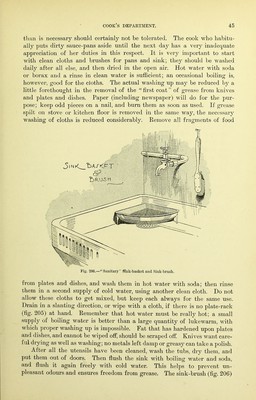
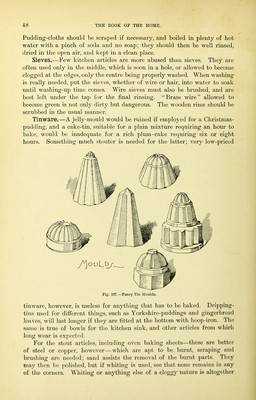
![Pudding-cloths should be scraped if necessary, and boiled in plenty of hot water with a pinch of soda and no soap; they should then be well rinsed, dried in the open air, and kept in a clean place. Sieves.—Few kitchen articles are more abused than sieves. They are often used only in the middle, which is soon in a hole, or allowed to become clogged at the edges, only the centre being properly washed. When washing is really needed, put the sieves, whether of wire or hair, into water to soak until washing-up time comes. Wire sieves must also be brushed, and are best left under the tap for the final rinsing. “ Brass wire ” allowed to become green is not only dirty but dangerous. The wooden rims should be scrubbed in the usual manner. Tinware.—A jelly-mould would be ruined if employed for a Christmas- pudding, and a cake-tin, suitable for a plain mixture requiring an hour to bake, would be inadequate for a rich plum-cake requiring six or eight hours. Something much stouter is needed for the latter; ver}^ low-priced tinware, however, is useless for anything that has to be baked. Dripping- tins used for different things, such as Yorkshire-puddings and gingerbread loaves, will last longer if they are fitted at the bottom with hoop-iron. The same is true of bowls for the kitchen sink, and other articles from which long wear is expected. For the stout articles, including oven baking sheets—these are better of steel or copper, however—which are a])t to be burnt, scraping and brushing are needed; sand assists the removal of the burnt parts. They may then be polished, but if whiting is used, see that none remains in any of the corners. Whiting or anything else of a cloggy nature is altogether Fig. 207.—Fancy Tin Moulds.](https://iiif.wellcomecollection.org/image/b21505883_0003_0066.jp2/full/800%2C/0/default.jpg)