J.L. Pulvermacher's patent portable hydro-electric voltaic chains : Sold by J. Steinert, sole agent, no. 568 Broadway, New York.
- Pulvermacher, J. L.
- Date:
- [1853]
Licence: Public Domain Mark
Credit: J.L. Pulvermacher's patent portable hydro-electric voltaic chains : Sold by J. Steinert, sole agent, no. 568 Broadway, New York. Source: Wellcome Collection.
Provider: This material has been provided by the Francis A. Countway Library of Medicine, through the Medical Heritage Library. The original may be consulted at the Francis A. Countway Library of Medicine, Harvard Medical School.
35/40 page 31
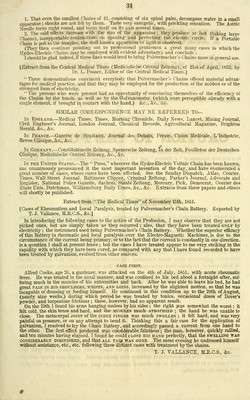
![1. That even the smallest Chains of $1, consisting of six spiral pairs, decompose water in a small apparatus; shocks are not felt by them. Taste very energetic, with prickling sensation. The Asttic Needle turns right round, and turns itself on its axis several times. 2. The said clfects increase with the size of the apparatus; they produce at last (taking large Chains), insupportable'contractions on opening and perfecting the electric circle. If a Portable Chain is put to the temples, the well known apparition of light is observed. (They then continue pointing out to professional gentlemen a great many cases in which the Hydro-Electric Chains maybe employed with evident advantage) and conclude : I should be glad indeed, if these lines would tend to bring Pulvermachcr's Chains more in general use. [Extract from the Central Medical Times (Medicinische Central Zeitung), of 21st of April, 1852, by Dr. L. Posner, Editor of the Central Medical Times.] These demonstrations convinced everybody that Pulvermachcr's Chains offered material advan- tages for medical practice, and that they may be employed for the production of the mildest or of the strongest form of electricity. The persons who were present had an opportunity of convincing themselves of the efficiency of the Chains by the touch, as well as by the Galvanometer (which were perceptible already with a single clement, if brought in contact with the hand,) &c, &c, &c. SIMILAR CORRESPONDENCE MAY BE REFERRED TO— In England.—Medical Times. Times, Morning Chronicle, Daily News, Lancet, Mining Journal, Civil Engineei^'s Journal, London Journal, Chemical Records, Agricultural Magazine, Brighton Herald, &c, &c. In France.—Gazette de Hopitaux, Journal des Debats, Presse, Union Medicale, L'Industrie, Revue Clinique,&c., &c. In Germany.—Constitutionelle Zeitung, Spenersche Zeitung, In der Zeit, Feuilleton der Deutschen Clinique, Medizinische Central Zeitung, &c, &c. In the United States.—The Press, wherever the Hydro-Electric Voltaic Chain has been known, nas unanimously pronounced it the most important invention of the day, and have enumerated a great number of cases, where cures have been effected. See the Sunday Dispatch, Atlas, Courier. Times, Wall Street Journal, Baltimore Clipper, Criminal Zeitung, Parker's Journal, Advocate and Register, National Police Gazette, Sachem, Staats Zeitung, Mercury, Pick, Democrat, Courier des Etats Unis, Dutchman, Williamsburg Daily Times, &c, &c. Extracts from these papers and others will shortly be published. Extract from '■' The Medical Times of November 15th, 1851. [Cases of Rheumatism and Local Paralysis, treated by Pulvermacher's Chain Battery. Reported by T. J. Vallance, M.R.C.S., &c] In introducing the following cases to the notice of the Profession, I may observe that they are not picked ones, but are simply taken as they occurred ; also, that they have been treated only by electricity ; the instrument used being Pulvermacher's Chain Battery. Whether the superior efficacy of this Battery in rheumatic and local paralysis over the Electro-Magnetic Machines, is due to the circumstance of the current being primary, or to the fact that the current is constantly in one direction. is a question 1 shall at present leave; but the cases I have treated appear to me very striking in the rapidity with which they have been cured, as compared with any that I have found recorded to have been treated by galvanism, evolved from other sources. CASE FIRST. Alfred Cooke, age 26, a gardener, was attacked on the 4th of July, 1851, with acute rheumatic fever. He was treated in the usual manner, and was confined to his bed about a fortnight after, suf- fering much in the muscles of his extremities and back. After he was able to leave his bed, he had great pain in his shoulders, wrists, and loins, increased by the slightest motion, so that he was incapable of dressing or feeding himself. He continued in this condition up to the 29th of August, (nearly nine weeks,) during which period he was treated by tonics, occasional doses of Dover's powder, and turpentine frictions ; these, however, had no apparent result. On the 29th I found his arms hanging useless by his sides ; the right was somewhat the worst; it felt cold, the skin tense and hard, and the muscles much atrophied ; the hand he was unable tc close. The metacerpalJOiNT of the index finger was much swollen ; it felt hard, and was very painful on pressure, or on any attempt to bend it. Thinking this a fair case for the application of galvanism, I resolved to try the Chain Battery, and accordingly passed a current from one hand to the other. The first effect produced was considerable faintness ; the man, however, quickly rallied, and ten minutes having elapsed. I found he could close his hand perfectly, that the swelling was considerably diminished, and that all PAiji was gone. The same evening he undressed himself without assistance, etc., etc. following three distinct cases with treatment by the chains. T. J. VALLANCE, M.R.C.S., &c.](https://iiif.wellcomecollection.org/image/b21073296_0035.jp2/full/800%2C/0/default.jpg)
 No text description is available for this image
 No text description is available for this image
 No text description is available for this image